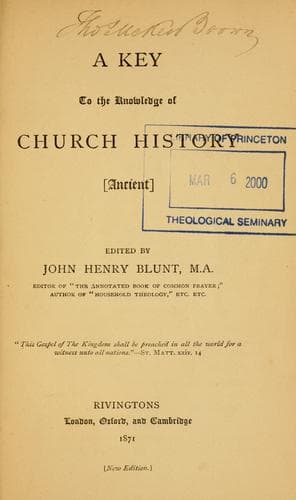
A Key to the Knowledge of Church History (Ancient)Blunt, John Henry
History
A Key to the Knowledge of Church History (Ancient)
Blunt, John Henry
Church history -- Middle Ages, 600-1500; Church history -- Primitive and early church, ca. 30-600
V. The Fifth General Council was summoned at Constantinople by the
Emperor Justinian, A.D. 533, and was attended by 165 Bishops. In it
the decisions of the Four First Councils were confirmed, especially
against the Nestorians.
[Sidenote: VI. Council.]
VI. The Sixth General Council was also held at Constantinople, A.D.
680, by command of the Emperor Constantine Pogonatus, and condemned a
development of Eutychianism.
{72}
Table of Councils.
Where held. Date. Emperor. Object.
I. Nicaea 325 Constantine Against the Arians.
the Great
II. Constantinople 38l Theodosius Against the
the Great Macedonians.
III. Ephesus 431 Theodosius Against the
the Younger Nestorians.
IV. Chalcedon 451 Marcian Against the
Eutychians.
V. Constantinople 553 Justinian Against a
development of
Nestorianism.
VI. Constantinople 680 Constantine Against a
Pogonatus development
of Eutychianism.
Section 4. _Intellectual Development in the Church._
[Sidenote: Christian learning developed in peace.]
This portion of the History of the Church, comprising as it does the
first period in which the master-minds within her fold were left free
by the cessation of outward persecution to resist the increasing
attacks of heresy, may be looked upon as offering to our view the
greatest intellectual development which the Church has experienced
since the times of the Apostles. [Sidenote: The Fathers.] Learned and
eloquent men abounded, "mighty in the Scriptures" and "steadfast in the
Faith," and their commentaries and sermons have come down to us as an
abiding heritage and a continual witness to the teaching of the Church
in early times. St. Athanasius, St. Ambrose, St. Chrysostom, and St.
Augustine, are but a few out of many whose writings are still held in
honour by our own as well as by every other branch of the Catholic
Church.
[1] A General Council is the highest possible way in which the voice of
the Church can be heard. But its authority is much increased by the
fact that to become really a _general_ Council its decrees must be
generally received by the Christian world. This was the case with the
first six General Councils, but has not been entirely so with any
similar gatherings of later ages.
[2] That part of the Creed which follows the words, "I believe in the
Holy Ghost," was added later.
[3] The subsequent addition in the clause, "Who proceedeth from the
Father and the Son," will be noticed later.
{73}
CHAPTER VII
The Early History of Particular Churches.
A.D. 67-A.D. 500
Public-domain text, read in full here on John Shaqi.
Reviews
Reviews
No reviews yet
Be the first to share your thoughts on this work.
Join the Discussion
Join the discussion
Sign in to leave a comment or review.
Sign InorCreate an account