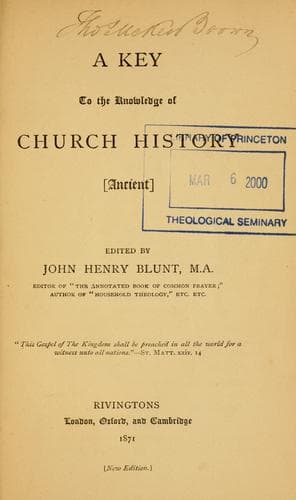
A Key to the Knowledge of Church History (Ancient)Blunt, John Henry
History
A Key to the Knowledge of Church History (Ancient)
Blunt, John Henry
Church history -- Middle Ages, 600-1500; Church history -- Primitive and early church, ca. 30-600
Section 1. _The Church of England._
[Sidenote: St. Paul's visit to England.]
The CHURCH OF ENGLAND is believed, with good reason, to owe its
foundation to the Apostle St. Paul, who probably came to this country
after his first imprisonment at Rome. The writings of Tertullian, and
others in the second and third centuries speak of Christianity as
having spread as far as the islands of Britain, and a British king
named Lucius is known to have embraced the Faith about the middle of
the second century. [Sidenote: Martyrdom of St. Alban.] The Diocletian
persecution made itself felt amongst the British Christians, the
conversion of the proto-martyr St. Alban (A.D. 303) being followed by
that of a large number of his countrymen, many of whom also suffered
for their faith.
The persecution ceased (A.D. 305) under the influence of Constantius,
who, before his accession to the imperial dignity, had been viceroy in
Britain. His son and successor Constantine was, if not born in
England, at any rate of English parentage on the side of his mother
Helen, better known as the Saint and Empress {74} Helena. [Sidenote:
English bishops at Councils.] Three English Bishops, those of York,
Lincoln, and London, attended the Council summoned by Constantine at
Arles, A.D. 314, a proof that at this time the Church of England was
thoroughly organized and settled. English Bishops were also present at
the Councils of Sardica, A.D. 347, and of Ariminium, A.D. 359.
[Sidenote: English Church depressed by Saxon invasion.]
When the Romans abandoned Britain early in the fifth century, the
Saxons took advantage of the defenceless state of the inhabitants to
settle in the island, at first as colonists and afterwards as
conquerors. The intermingling of these fierce heathens with the
Christian population had a depressing influence on the Church; and the
Bishops and Clergy, belonging as they did to the weaker and conquered
portion of the community, seem to have been unable to do much towards
the conversion of the invaders. [Sidenote: Diminution and retreat of
Clergy.] Gradually, as the Saxons became more and more powerful in the
island, the number of Bishops and Clergy in the accessible portions of
of England grew smaller and smaller; and such as remained were at last
compelled to take refuge with their brethren, who had retired to the
mountain fastnesses, rather than live in slavery. Hence the records of
the Church of England in the sixth century are chiefly confined to
those dioceses which were situated in what we call Wales, or in other
mountainous districts.
Section 2. _The Church of Ireland._
Public-domain text, read in full here on John Shaqi.
Reviews
Reviews
No reviews yet
Be the first to share your thoughts on this work.
Join the Discussion
Join the discussion
Sign in to leave a comment or review.
Sign InorCreate an account