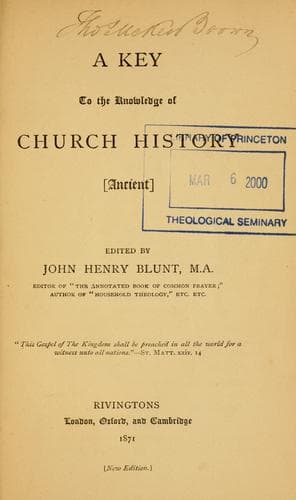
A Key to the Knowledge of Church History (Ancient)Blunt, John Henry
History
A Key to the Knowledge of Church History (Ancient)
Blunt, John Henry
Church history -- Middle Ages, 600-1500; Church history -- Primitive and early church, ca. 30-600
The CHURCH IN ANTIOCH having been probably founded by St. Peter, that
Apostle is believed to have left behind him two Bishops in the city,
the one Evodius, having the episcopal care of the Jewish converts,
whilst Ignatius was placed in charge of the Gentile Christians; but, on
the death of Evodius, A.D. 70, Ignatius became sole Bishop. [Sidenote:
St. Ignatius.] This holy man is said to have been the child whom our
Lord took in His arms and set in the midst of His disciples. He was
intimate with some or all of the Apostles, especially with St. John,
and was martyred by being thrown to wild beasts at Rome, A.D. 107. The
synods held at Antioch were very numerous, and far larger than any
others, approaching almost in size and importance to General Councils.
[Sidenote: St. John Chrysostom.] It was at Antioch that the celebrated
and eloquent St. John Chrysostom was born about A.D. 347: he became
Bishop of Constantinople, and died A.D. 407, after undergoing
persecutions which almost amounted to a martyrdom.
[Sidenote: St. Paul and St. John in Asia Minor.]
We have already seen (pp. 31, 32) that the CHURCHES OF ASIA MINOR owe
their foundation chiefly to St. Paul, whilst their perfect organization
and development was entrusted to St. John the Divine (pp. 49 to 51).
The Seven Churches of the Apocalypse seem to have been in a special
manner the charge of the latter Apostle, Ephesus, the chief of them,
being the home of his later earthly years, and the scene of his decease
and burial. [Sidenote: The "Angels" of the Seven Churches.] St.
Timothy, the first Bishop of Ephesus, had been succeeded probably by
Onesimus; St. Polycarp (martyred A.D. 167) had the episcopal charge of
Smyrna; {85} Archippus, it is believed, had followed Epaphras at
Laodicea. The names of the other "Angels" spoken of in the Apocalypse
have not come down to us, but there is no doubt that at the time when
the seven inspired Epistles were addressed to these Churches, there was
in each of them a firmly established episcopacy, and that this form of
government was followed by all other Churches throughout the world.
There is little that needs recording of the history of these Churches
of Asia Minor, unless we except the Great Council of Ephesus, held in
that city, A.D. 431, to condemn the heresy of Nestorius (p. 71).
[Sidenote: St. Bartholomew in Armenia.]
The CHURCH OF ARMENIA, now included in Asiatic Turkey, is believed to
have been first founded by St. Bartholomew. The country is said to
have been further evangelized by a mission sent by St. Gregory the
Illuminator in the third century. It is known that, in the following
century, a flourishing Church existed there.
[Sidenote: Several Apostles in Parthia.]
Public-domain text, read in full here on John Shaqi.
Reviews
Reviews
No reviews yet
Be the first to share your thoughts on this work.
Join the Discussion
Join the discussion
Sign in to leave a comment or review.
Sign InorCreate an account