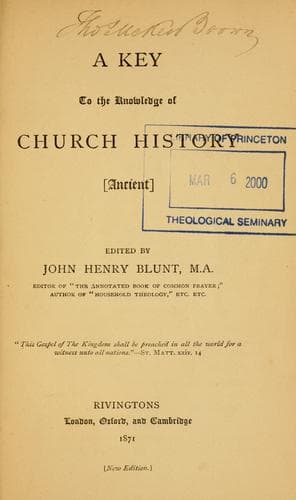
A Key to the Knowledge of Church History (Ancient)Blunt, John Henry
History
A Key to the Knowledge of Church History (Ancient)
Blunt, John Henry
Church history -- Middle Ages, 600-1500; Church history -- Primitive and early church, ca. 30-600
The CHURCH OF PARTHIA, or PERSIA, embraced the country lying between
the Tigris and the Indus, with Mesopotamia and Chaldea; what we now
call Persia, Cabul, and Belochistan; as well as part of Arabia and
Turkey; and is said to have been planted by St. Peter, St. Bartholomew,
St. Jude, St. Matthew, and St. Thomas. The inhabitants of this region
were of different races: Greek colonists; many Jews, the residue of the
Babylonish Captivity; Arabs, and ancient Persians. Till the fourth
century the Parthian Church appears to have flourished in peace. It
was beyond the jurisdiction of the persecuting emperors of Rome, and
the Parthian monarchs, though not Christians themselves, protected or
tolerated their Christian subjects. [Sidenote: Persecution there.] Two
Bishops were sent from {86} Parthia to the Council of Nicaea, A.D. 323,
but shortly afterwards, A.D. 330, persecution broke out, occasioned
apparently by the jealousy felt by the king towards the now Christian
emperors of Rome, and the intercourse kept up between the fellow
Christians of the two empires. Sixteen thousand martyrs are said to
have shed their blood for their Faith, and amongst them was St. Simeon,
the Patriarch of the Church, and Bishop of Seleucia. Another
persecution took place in the beginning of the fifth century, and
shortly afterwards Persian Christianity became strongly infected with
the errors of Nestorius, the Shahs apparently favouring the heresy on
account of its having been discouraged by the Roman emperors.
[Sidenote: Uncertainty as to the first conversion of Arabia.]
There is no record of the actual founding of the CHURCH IN ARABIA. We
know, from Gal. i. 17, that St. Paul "went into Arabia" soon after his
conversion, but there is no mention of his having preached the Gospel
there at that time, when indeed he was not yet called to be an Apostle;
and the Arabia to which he went was probably the northern portion
stretching up to the east of Syria, almost to Damascus itself. The
Apostle of the Gentiles may probably have revisited this country at a
later period; but, at any rate, we know that Christianity was firmly
established there early in the third century, and that Origen made two
several journeys thither between A.D. 220 and A.D. 248, to combat
heresies which troubled the Arabian Church. The Bishop of Bostra, or
Bozrah, was present at the Council of Antioch, A.D. 269. [Sidenote:
Nestorianism and Eutychianism in Arabia.] In the fifth century the
errors of Nestorius, and, a little later, of Eutyches, made great
inroads amongst {87} the Christians of Arabia, several even of the
Bishops being led away by them.
[Sidenote: St. Thomas and St. Bartholomew in India.]
Public-domain text, read in full here on John Shaqi.
Reviews
Reviews
No reviews yet
Be the first to share your thoughts on this work.
Join the Discussion
Join the discussion
Sign in to leave a comment or review.
Sign InorCreate an account