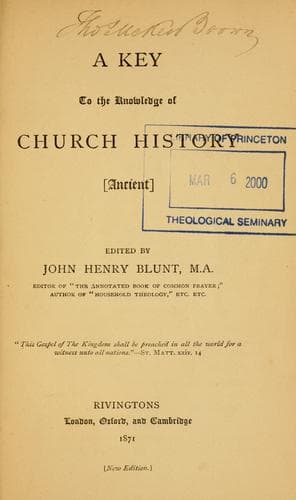
A Key to the Knowledge of Church History (Ancient)Blunt, John Henry
History
A Key to the Knowledge of Church History (Ancient)
Blunt, John Henry
Church history -- Middle Ages, 600-1500; Church history -- Primitive and early church, ca. 30-600
Nor were the personal characters of the Popes who filled the see of
Rome during the remainder of the century, such as to encourage any
expectation that their influence would be employed to revive religion,
or to encourage holy living. Worldliness and ambition, revenge and
immorality, cast a deep shadow over the records of the papacy at this
time, until the century closes with the reign of Alexander VI., or
{111} Roderigo Borgia (A.D. 1492-A.D. 1503), who was elected by
bribery, and whose shameless vice and cruelty brought greater scandals
upon the Church than any of his predecessors had done.
Section 3. _The Monastic Orders._
Monastic orders, though not by any means an invention of the Middle
Ages, may yet fairly be said to have attained their height, both of
prosperity and of usefulness, during this period of Church History.
[Sidenote: Early rise of monasticism.] We may trace the origin of
Christian monastic life to very early times, when persecution drove
many Christians to a life of loneliness and privation in desert places.
The mode of life thus begun from necessity was afterwards continued
from choice, and in the hope of more complete self-devotion to God's
service; and the solitary hermits and anchorites of primitive ages
became the forerunners of an elaborate system of religious communities
of men and women.
[Sidenote: Later influences brought to bear on it.]
St. Basil, in the fourth century, brought monasticism into a more
definite form, and St. Athanasius during the same century introduced it
into Europe from the East. In the West the religious life spread and
flourished under the fostering care of such men as St. Augustine and
St. Gregory the Great, whilst by St. Benedict in the sixth century it
was developed into the famous Benedictine rule, to which, with few
exceptions, all the European monasteries conformed, and which was the
parent of various minor orders or subdivisions[1].
{112}
[Sidenote: Beneficial results of monasticism.]
Public-domain text, read in full here on John Shaqi.
Reviews
Reviews
No reviews yet
Be the first to share your thoughts on this work.
Elsewhere in the archive
Join the Discussion
Join the discussion
Sign in to leave a comment or review.
Sign InorCreate an account