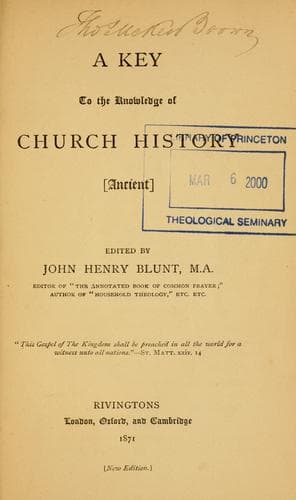
A Key to the Knowledge of Church History (Ancient)Blunt, John Henry
History
A Key to the Knowledge of Church History (Ancient)
Blunt, John Henry
Church history -- Middle Ages, 600-1500; Church history -- Primitive and early church, ca. 30-600
It is from this Sarum Use that our present Post-Reformation
Liturgy is derived.
A very considerable amount of new life and energy was infused into the
Church of England by the mission of St. Augustine. Though the native
Bishops and Clergy could not bring themselves to look cordially
on those {144} whose religious zeal was not always tempered with
justice or courtesy towards their predecessors in the field of their
missionary labours, still both foreigners and natives worked for the
same cause, each in their own way, and a new evangelization of the
freshly-heathenized population ensued[1]. [Sidenote: Amalgamation of
English and Roman successions.] By degrees the two lines of Bishops
became blended in one succession, which has continued unbroken until
the present day.
[Sidenote: English missionary zeal.]
The Church of England, thus strengthened and quickened, soon began to
give abundant proofs of its vitality by sending out missionaries to
convert the heathen in other lands. A large part of Germany and the
Netherlands owes its Christianity to English Bishops and Clergy, such
as Winfrith or Boniface, Willebrord, and a host of other less
well-known or altogether forgotten names. The eighth century was
especially distinguished by these missionary labours abroad, whilst, at
home, were to be found such good and learned men as the Venerable Bede
(A.D. 672 or '3-A.D. 735), an early translator of the Holy Scriptures,
and his friend Egbert (A.D. about 678-A.D. 776), Archbishop of York,
and founder of a famous school in that city, where the illustrious
Alcuin (about A.D. 723-A.D. 804) was a scholar.
[Sidenote: Invasion, and conversion of the Danes.]
In A.D. 787, the Church of England began to suffer severely from the
ravages of the heathen Danes or Northmen; but, by the wisdom and valour
of the good King Alfred (A.D. 871-A.D. 901), {145} they were for a
while subdued, and numbers of them settled as peaceable colonists in
England, where they gradually embraced Christianity.
[Sidenote: King Alfred.]
Public-domain text, read in full here on John Shaqi.
Reviews
Reviews
No reviews yet
Be the first to share your thoughts on this work.
Elsewhere in the archive
Join the Discussion
Join the discussion
Sign in to leave a comment or review.
Sign InorCreate an account