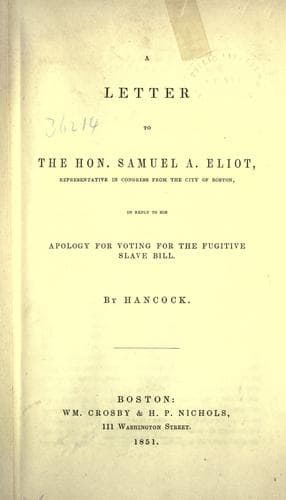
A Letter to the Hon. Samuel A. Eliot, Representative in Congress From the City of Boston, In Reply to His Apology For Voting For the Fugitive Slave Bill.Dexter, Franklin
Philosophy
A Letter to the Hon. Samuel A. Eliot, Representative in Congress From the City of Boston, In Reply to His Apology For Voting For the Fugitive Slave Bill.
Dexter, Franklin
Eliot, Samuel Atkins, 1798-1862; Fugitive slave law of 1850; Slavery -- United States
Produced by Meredith Bach, Odessa Paige Turner and the
Online Distributed Proofreading Team at https://www.pgdp.net
(This book was produced from scanned images of public
domain material from the Google Print project.)
A
LETTER
TO
THE HON. SAMUEL A. ELIOT,
REPRESENTATIVE IN CONGRESS FROM THE CITY OF BOSTON,
in reply to his
APOLOGY FOR VOTING FOR THE FUGITIVE
SLAVE BILL.
BY HANCOCK
BOSTON:
WM. CROSBY & H. P. NICHOLS,
111 WASHINGTON STREET.
1851.
CAMBRIDGE:
METCALF AND COMPANY,
PRINTERS TO THE UNIVERSITY.
A LETTER, &c.
SIR;--
An English courtier procured a colonial judgeship for a young dependant
wholly ignorant of law. The new functionary, on parting with his patron,
received from him the following sage advice,--"Be careful never to
assign reasons, for whether your judgments be right or wrong, your
reasons will certainly be bad." You have cause to regret that some
friend had not been equally provident of your reputation, and intimated
that it was only expected of you to vote for Mr. Webster's measures, but
by no means to assist him in vindicating them. You did, indeed, vote
precisely as those who procured your nomination intended you should;
yet, on your return home, you found your name had become a byword and a
reproach in your native State. Another election approached, but you
declined submitting your recent course to the judgment of the electors,
and withdrew from the canvass. But although the people were thus
prevented from voting against you, they persisted in speaking and
writing against you. Anxious to relieve yourself from the load of
obloquy by which you were oppressed, in an evil hour you rashly appealed
to the public through the columns of a newspaper, and gave the "reasons"
of your vote for the Fugitive Slave Law. You had a high and recent
example of the kind of logic suited to your case. You might have
indulged in transcendental nonsense, and talked about the climate,
soil, and scenery of New England and the wonders of physical geography,
and, assuming that negroes were created free, you might have contended
that, in voting for a law to catch and enslave them, you had avoided the
folly of reenacting the law of God. Reasons of this sort, you and others
had declared, "had convinced the understanding and touched the
conscience of the nation." Instead of following an example so
illustrious and successful, you assign "reasons" so very commonplace,
that the most ordinary capacity can understand them, and so feeble, that
the slightest strength can overthrow them.
Public-domain text, read in full here on John Shaqi.
Reviews
Reviews
No reviews yet
Be the first to share your thoughts on this work.
Join the Discussion
Join the discussion
Sign in to leave a comment or review.
Sign InorCreate an account