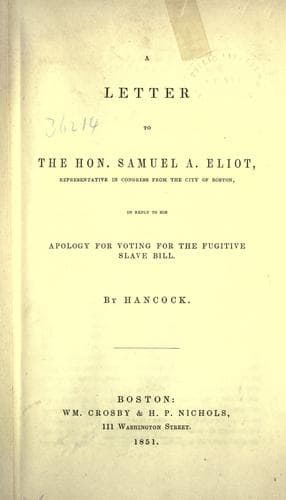
A Letter to the Hon. Samuel A. Eliot, Representative in Congress From the City of Boston, In Reply to His Apology For Voting For the Fugitive Slave Bill.Dexter, Franklin
Philosophy
A Letter to the Hon. Samuel A. Eliot, Representative in Congress From the City of Boston, In Reply to His Apology For Voting For the Fugitive Slave Bill.
Dexter, Franklin
Eliot, Samuel Atkins, 1798-1862; Fugitive slave law of 1850; Slavery -- United States
Your first "reason" is, that the delivery of fugitives is a
constitutional obligation. By this you mean, that, by virtue of the
construction of a certain clause in the Constitution by the Supreme
Court, Congress has the power to pass a law for the recovery of fugitive
slaves. Well, Sir, does this constitutional obligation authorize
Congress to pass _any_ law whatsoever on the subject, however atrocious
and wicked? Had you voted for a law to prevent smuggling, in which you
had authorized every tide-waiter to shoot any person suspected of having
contraband goods in his possession, would it have been a good "reason"
for such an atrocity, that the collection of duties was "a
constitutional obligation"? You are condemned for voting for an
arbitrary, detestable, diabolical law,--one that tramples upon the
rights of conscience, outrages the feelings of humanity, discards the
rules of evidence, levels all the barriers erected by the common law for
the protection of personal liberty, and, in defiance of the
Constitution, and against its express provisions, gives to the courts
the appointment of legions of slave-catching judges. And your "reason"
for all this is, that the delivery of fugitives is "a constitutional
obligation"! The "obligation" is not in issue. Please to understand,
Sir, that it is not denied. It is for the _manner_ in which you profess
to have discharged the obligation that you are censured, and be it
remembered, that not one of the obnoxious provisions of your law is
required by the Constitution. You go on and attempt to enlighten your
constituents as to the history of this constitutional obligation. As the
obligation affords you no apology for the iniquitous features of your
law, its history is, of course, mere surplusage, and serves no other
purpose than to divert the attention of your readers from yourself.
About two thirds of your apology is occupied with an historical
disquisition, which has as much to do with your vindication as the
question respecting the existence of a lunar atmosphere. I will not,
however, withhold from you whatever benefit you may derive from either
your logic or your history, but will give each a fair and honest
examination. You inform the public that, at the time the Constitution
was formed,
Public-domain text, read in full here on John Shaqi.
Reviews
Reviews
No reviews yet
Be the first to share your thoughts on this work.
Join the Discussion
Join the discussion
Sign in to leave a comment or review.
Sign InorCreate an account