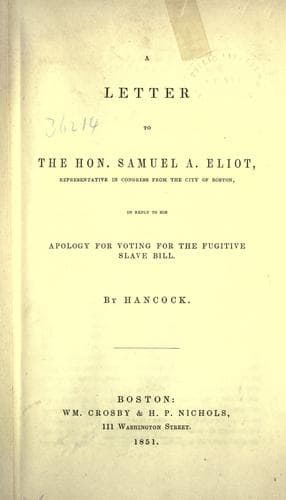
A Letter to the Hon. Samuel A. Eliot, Representative in Congress From the City of Boston, In Reply to His Apology For Voting For the Fugitive Slave Bill.Dexter, Franklin
Philosophy
A Letter to the Hon. Samuel A. Eliot, Representative in Congress From the City of Boston, In Reply to His Apology For Voting For the Fugitive Slave Bill.
Dexter, Franklin
Eliot, Samuel Atkins, 1798-1862; Fugitive slave law of 1850; Slavery -- United States
It does not appear from Mr. Madison's report what reply was made in the
Convention to the Virginia objections, but in his speech in the
Convention of his own State, he tells us,--"The gentlemen from South
Carolina and Georgia argued in this manner: We have now liberty to
import this species of property, and much of the property now possessed
had been purchased or otherwise acquired in contemplation of improving
it by the assistance of imported slaves. What would be the consequence
of hindering us in this point? The _slaves_ of Virginia would rise in
value, and we should be obliged to go to your markets." (_Elliott's
Debates_, III. 454.) Certainly, Sir, these South Carolina and Georgia
delegates were "very wise men," and their predictions are now history,
and the planters of Georgia, South Carolina, Mississippi, and Louisiana
buy slaves of the Virginia breeders. But what shall I say of the wise
men from the East? This horrible compromise, this guarantee of the
African slave-trade for twenty years, was carried by the votes of the
Massachusetts and Connecticut delegates, and would have been defeated,
had they had the courage and virtue to have voted against it.
I have indulged in this long digression, to show that the clause in the
Constitution respecting fugitive slaves was not, as you represent it,
the great compromise of the Constitution, the key-stone of the Union,
and that our slaveholding fathers were not, as you suppose, greatly
perplexed, nor their consciences deeply wounded, by the existence of
slavery in all the States of the confederacy with one exception. Having
disposed of your history, I return to your logic.
Public-domain text, read in full here on John Shaqi.
Reviews
Reviews
No reviews yet
Be the first to share your thoughts on this work.
Join the Discussion
Join the discussion
Sign in to leave a comment or review.
Sign InorCreate an account