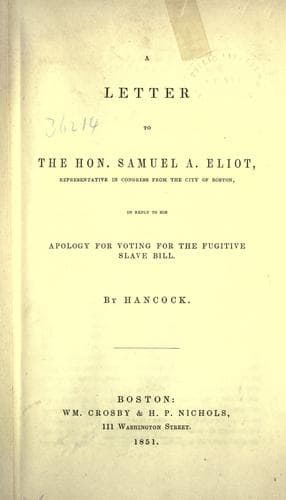
A Letter to the Hon. Samuel A. Eliot, Representative in Congress From the City of Boston, In Reply to His Apology For Voting For the Fugitive Slave Bill.Dexter, Franklin
Philosophy
A Letter to the Hon. Samuel A. Eliot, Representative in Congress From the City of Boston, In Reply to His Apology For Voting For the Fugitive Slave Bill.
Dexter, Franklin
Eliot, Samuel Atkins, 1798-1862; Fugitive slave law of 1850; Slavery -- United States
you allude were made in reference to the continuance of the African
slave-trade, and not, as you suppose, to the catching of fugitive
slaves. Two New England gentlemen of the committee yielded to these
declarations, and sacrificed conscience and humanity for the sake of the
Union, and the consideration that what enriched a part enriched the
whole. Happily, in this case, Southern bluster was met by Southern
bluster, and it is owing to Virginia, and not to the virtue and
independence of New England, that the Constitution was rescued from the
infamy of granting a solemn and perpetual guarantee to an accursed
commerce.
In Virginia, the slaves, as Mr. Ellsworth remarked, multiplied so fast,
that it was _cheaper_ to raise than import them. She was then, as now, a
breeding State for the Southern markets. Hence, her delegates were as
ready to bluster for protection, as the South Carolina delegates were
for a free trade in men and women. Of course, the _motives_ assigned
were patriotic, not selfish. Mr. Randolph "could never agree to the
clause as it stands. He would sooner RISK THE CONSTITUTION." (_Madison
Papers_, p. 1396.) Mr. Madison would not consent to the continuance of
the traffic till 1808. "Twenty years will produce all the mischief that
can be apprehended from the liberty to import slaves. So long a term
will be more dishonorable to the American character, than to say nothing
about it in the Constitution." (_Madison Papers_, p. 1427.) Mr. Mason
from Virginia denounced the traffic as "infernal." (_Madison Papers_, p.
1390.) The result of all these threats on each side was, as usual, a
compromise, by which Congress was prohibited from suppressing the
foreign and internal commerce in slaves for twenty years, and was left
at liberty to do as it might see fit, after that period. After twenty
years the foreign trade was suppressed, and North and South Carolina and
Georgia remained in the Union! Virginia, as well as the other Slave
States, is greatly interested in the home slave-trade, and that has
_not_ been suppressed, although Congress has full power over it.
Public-domain text, read in full here on John Shaqi.
Reviews
Reviews
No reviews yet
Be the first to share your thoughts on this work.
Join the Discussion
Join the discussion
Sign in to leave a comment or review.
Sign InorCreate an account