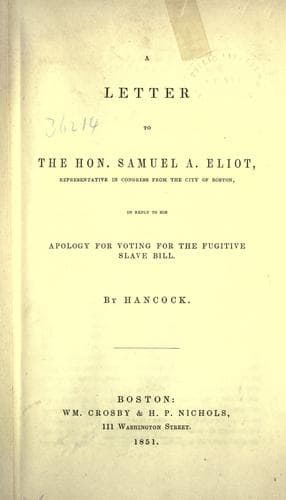
A Letter to the Hon. Samuel A. Eliot, Representative in Congress From the City of Boston, In Reply to His Apology For Voting For the Fugitive Slave Bill.Dexter, Franklin
Philosophy
A Letter to the Hon. Samuel A. Eliot, Representative in Congress From the City of Boston, In Reply to His Apology For Voting For the Fugitive Slave Bill.
Dexter, Franklin
Eliot, Samuel Atkins, 1798-1862; Fugitive slave law of 1850; Slavery -- United States
were committing, the new law is more favorable to the fugitive than the
old one. Surely, Sir, it could not have been more perilous to the young
West Indian judge to meddle with "reasons," than it is for you. Either,
Sir, you voted for the law without reading it, or you have forgotten its
provision. Be assured, the Southern lawyers were as well acquainted as
yourself with the fact, that a few individuals, termed "commissioners,"
had been appointed by the United States courts to perform certain
ministerial acts; and that, as these men were now to be promoted to the
office of slave-catching judges, they would be wholly inadequate in
number to lend efficient aid to the hunters of men. Hence, they inserted
in the third section of the bill, the following enactment, which has
strangely escaped your recollection, viz.:--"And it is further enacted,
that the Circuit Courts of the United States, and the Superior Courts of
_each_ organized Territory of the United States, SHALL from time to time
ENLARGE THE NUMBER OF COMMISSIONERS with a view to afford reasonable
facilities to reclaim fugitives from labor, and to the prompt discharge
of the duties imposed by this act." So that, instead of six or eight
commissioners in a State, we are to have as many hundreds, if needed.
Nor is this all. By the second section, the power possessed by the
Circuit Courts to appoint commissioners is for the first time conferred
on the _Territorial_ courts, so that there shall be no lack of
slave-catching judges in Oregon, Utah, and New Mexico. Instead of your
six or eight commissioners in a State, your law contemplates that there
shall be one or more in _each county_; for the fifth section provides,
that, "the better to enable the said commissioners to execute their
duties faithfully and efficiently, ... they are hereby authorized and
empowered, within their _counties respectively_," to appoint one or more
persons to execute their warrants. So it seems we are to have an
unlimited number of judges and executioners. These executioners,
expressly appointed to catch slaves, and of course among the most
worthless and degraded of the community, are one and all invested with
the power of a high sheriff to call out the _posse comitatus_, not
merely in his own county, but in every hamlet in the State, and require
"good citizens," under pain of fine and imprisonment, to join him in his
execrable hunt. Really, Sir, your "evidence" that the new law is more
favorable to the fugitive than the old one falls short of demonstration.
Public-domain text, read in full here on John Shaqi.
Reviews
Reviews
No reviews yet
Be the first to share your thoughts on this work.
Join the Discussion
Join the discussion
Sign in to leave a comment or review.
Sign InorCreate an account