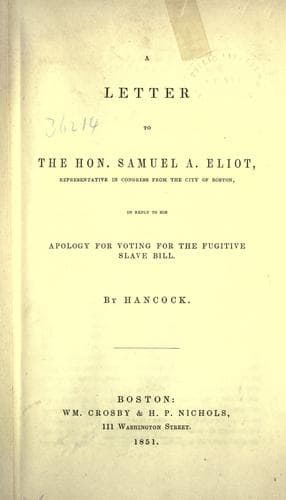
A Letter to the Hon. Samuel A. Eliot, Representative in Congress From the City of Boston, In Reply to His Apology For Voting For the Fugitive Slave Bill.Dexter, Franklin
Philosophy
A Letter to the Hon. Samuel A. Eliot, Representative in Congress From the City of Boston, In Reply to His Apology For Voting For the Fugitive Slave Bill.
Dexter, Franklin
Eliot, Samuel Atkins, 1798-1862; Fugitive slave law of 1850; Slavery -- United States
You thus apologize for not giving the alleged fugitive a trial by jury.
"There was no more trial by jury provided for under the old law than
under the new law. The claim of a jury trial is entirely _new_; never
thought of till modern discussions of the subject begun. For fifty-seven
years our fathers and we have been living under the laws which provided
no such thing, and now one which makes no such provision is denounced in
unmeasured terms as cruel and inhuman. Where have we all been living for
half a century?" Surely, Sir, it is a most logical reason for not
changing a wicked law, that it has been in force for fifty-seven years.
Strange that the legislators of Massachusetts did not perceive the force
of this reasoning when they abolished the laws for hanging witches and
whipping Quakers. Permit me, Sir, to ask, Where had _you_ been living
when _you_ declared it to be the _duty_ of Congress to give the fugitive
a trial by jury, although for fifty-seven years such a trial had been
denied him? You probably forgot, Sir, when giving the above "reason,"
that, not long before you took your seat in Congress, you had, as a
member of the Massachusetts Legislature, voted for the following
resolution, viz.:--"We hold it to be the duty of that body [Congress] to
pass such laws only in regard thereto as will be maintained by the
public sentiment of the free States, where such laws are to be enforced,
and which shall especially secure all persons, whose surrender may be
claimed as having escaped from labor and service in other States, the
right of having the validity of such claim determined by a jury in the
State where such claim is made." So it seems that, while in Boston, you
esteemed it the _especial duty_ of Congress to grant the fugitive a
trial by jury, but that in the atmosphere of Washington you acquired new
views of moral philosophy.
Suffer me, Sir, also to inquire, Where had Mr. Webster been "living for
half a century," when, on the 3d of last June, he introduced into the
Senate a bill amendatory of the act of 1793, granting the alleged
fugitive a trial by jury whenever he shall make oath that he is not the
slave of the claimant?
Public-domain text, read in full here on John Shaqi.
Reviews
Reviews
No reviews yet
Be the first to share your thoughts on this work.
Join the Discussion
Join the discussion
Sign in to leave a comment or review.
Sign InorCreate an account