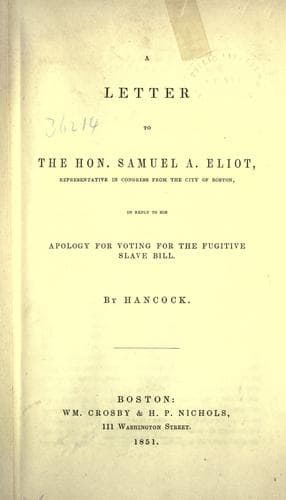
A Letter to the Hon. Samuel A. Eliot, Representative in Congress From the City of Boston, In Reply to His Apology For Voting For the Fugitive Slave Bill. — John Shaqi
A Letter to the Hon. Samuel A. Eliot, Representative in Congress From the City of Boston, In Reply to His Apology For Voting For the Fugitive Slave Bill.Dexter, Franklin
Philosophy
A Letter to the Hon. Samuel A. Eliot, Representative in Congress From the City of Boston, In Reply to His Apology For Voting For the Fugitive Slave Bill.
Dexter, Franklin
Eliot, Samuel Atkins, 1798-1862; Fugitive slave law of 1850; Slavery -- United States
some other person_; and inasmuch as the right is a right of property,
capable of being recognized and asserted by proceedings _before a court
of justice between parties adverse to each other_, it constitutes, in
the strictest sense, a _controversy_ between parties, and a case arising
under the Constitution of the United States, within the express
delegation of judicial power given by that instrument." (16 _Peters_,
616.) Hence your commissioners are, in the _strictest sense_, judges,
exercising "judicial power" delegated by the Constitution.
You pronounce Mr. Crittenden "legal authority of the highest kind." This
legal authority understands the sixth section of your law as providing
that each commissioner "shall have judicial power and jurisdiction to
hear, examine, and decide the case in a summary manner." Now, if a man,
having judicial power and jurisdiction to decide controversies between
parties adverse to each other, in controversies arising under the
Constitution and within the express delegation of judicial power given
by that instrument, is not a judge, do tell us who is one. Once more,
Sir, Mr. Crittenden says, "The legal authority of every tribunal of
exclusive jurisdiction, where no appeal lies, is of necessity
conclusive upon every tribunal; and therefore the judgment of the
tribunal created by this act is conclusive upon all other tribunals." So
your commissioner is not only a judge, but he constitutes a tribunal of
exclusive jurisdiction, and his judgment is binding even upon the
Supreme Court of the United States. And yet, Sir, you must deny that
this omnipotent commissioner is a judge, or you must admit, that, in the
mode of his appointment, you have flagrantly violated the Constitution
of your country.
Public-domain text, read in full here on John Shaqi.
Reviews
Reviews
No reviews yet
Be the first to share your thoughts on this work.
Join the Discussion
Join the discussion
Sign in to leave a comment or review.
Sign InorCreate an account