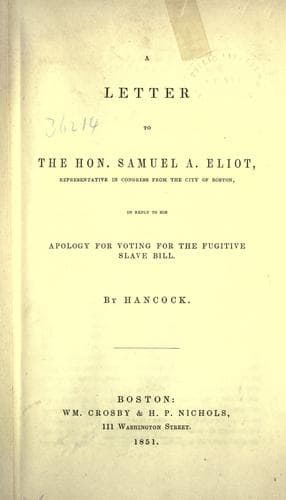
A Letter to the Hon. Samuel A. Eliot, Representative in Congress From the City of Boston, In Reply to His Apology For Voting For the Fugitive Slave Bill.Dexter, Franklin
Philosophy
A Letter to the Hon. Samuel A. Eliot, Representative in Congress From the City of Boston, In Reply to His Apology For Voting For the Fugitive Slave Bill.
Dexter, Franklin
Eliot, Samuel Atkins, 1798-1862; Fugitive slave law of 1850; Slavery -- United States
It has been most wickedly asserted by our proslavery presses and our
proslavery politicians, that the surrender of fugitives from labor and
fugitives from justice are similar proceedings. The surrender of a
fugitive slave involves two questions, that of identity and that of
property; and the law makes the decision of the commissioner on both
points final and conclusive upon every State and Federal court in the
land. The surrender of a fugitive criminal involves only the question of
personal identity. The Governor of the State issues his warrant for the
apprehension and delivery of a certain person proved to him to be
charged with felony. If the officer arrests the wrong person, he does it
at his peril, and a writ of _habeas corpus_ would immediately release
the person wrongfully arrested. Again, it is most fraudulently
maintained, that, if the wrong person is by the commissioner adjudged a
slave, he may sue for his freedom in a Southern court! Should he do so,
the exhibition of the commissioner's certificate is by law declared to
be conclusive _upon all tribunals_. But even supposing that a Southern
court, in defiance of law, should go behind the certificate, how is a
free colored person from the North, working under the lash on a
Mississippi plantation, to prove his freedom? How is he to fee a lawyer?
How is he to get into court? If once there, where are his witnesses?
They are his friends and acquaintances of his own color residing in the
North. How are they to be summoned to Mississippi? Should they venture
to enter the State, they would be imprisoned, and perhaps sold into
slavery; or even if permitted to enter the court-room, their testimony
would by law be excluded, against the claims of a white man. How
despicably profligate, then, is the assumption of the advocates of your
law, that any injustice committed under it would be repaired by Southern
courts!
Public-domain text, read in full here on John Shaqi.
Reviews
Reviews
No reviews yet
Be the first to share your thoughts on this work.
Join the Discussion
Join the discussion
Sign in to leave a comment or review.
Sign InorCreate an account