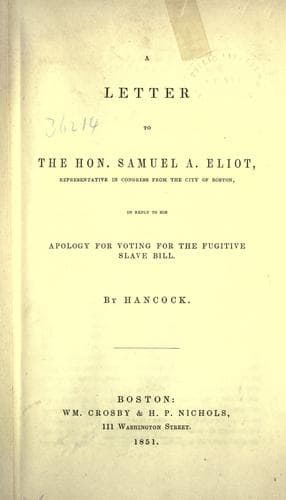
A Letter to the Hon. Samuel A. Eliot, Representative in Congress From the City of Boston, In Reply to His Apology For Voting For the Fugitive Slave Bill.Dexter, Franklin
Philosophy
A Letter to the Hon. Samuel A. Eliot, Representative in Congress From the City of Boston, In Reply to His Apology For Voting For the Fugitive Slave Bill.
Dexter, Franklin
Eliot, Samuel Atkins, 1798-1862; Fugitive slave law of 1850; Slavery -- United States
Such, Sir, is the _trial_ which you, the representative of Boston, a
descendant of the Pilgrims, and "a gentleman of property and standing,"
have accorded to the poor and oppressed. Did the Constitution require
such a prostitution of justice, such an outrage of humanity, at your
hands? I need not be told that some of your commissioners have not
construed your law as strictly as did the Detroit functionary. Thanks to
the force of public opinion, and to the zeal of some benevolent lawyers,
whose hearts were not padded with cotton, in some instances defendants
have been permitted to call witnesses in their behalf; and some regard
has been paid to the ordinary principles of justice. But in all such
instances, the spirit of the law and the intentions of its framers have
been frustrated.
And now let us listen to your "reason" for justifying all the atrocities
and abominations of your law. You gravely tell us, "The entire
population of the North has acquiesced in the law of 1793, without
thinking itself exposed to the charge of barbarity, and I have only to
say, that I do not think the charge any more just now." Certainly, Sir,
the young colonial judge could not have given a reason less logical or
satisfactory. You must be an inattentive observer of passing events, if
you are ignorant that the law of 1793 has again and again been denounced
as iniquitous, that some of the States have prohibited their officers
from assisting in its execution, that numberless petitions have been
presented to Congress for its repeal, and that you yourself, instead of
acquiescing in it, solemnly declared it to be the duty of Congress so
far to alter the law, as to grant the alleged fugitive a trial by jury.
Yet the law of 1793, wicked as it was, was justice and mercy compared
with yours. The trials under that were almost invariably before judges
of the State courts, not appointed like your commissioners for the vile
and only purpose of reducing their fellow-men to bondage. There judges
were not confined to _ex parte_ evidence, were not compelled to receive
"as full and conclusive" affidavits made in distant States, and by
unknown persons. For the most part, they honestly endeavoured, by a
patient investigation according to the ordinary rules of evidence, and
by holding the plaintiff to strict legal proof, to supply the want of a
jury.
Public-domain text, read in full here on John Shaqi.
Reviews
Reviews
No reviews yet
Be the first to share your thoughts on this work.
Join the Discussion
Join the discussion
Sign in to leave a comment or review.
Sign InorCreate an account