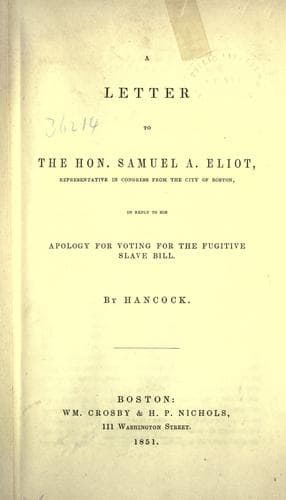
A Letter to the Hon. Samuel A. Eliot, Representative in Congress From the City of Boston, In Reply to His Apology For Voting For the Fugitive Slave Bill.Dexter, Franklin
Philosophy
A Letter to the Hon. Samuel A. Eliot, Representative in Congress From the City of Boston, In Reply to His Apology For Voting For the Fugitive Slave Bill.
Dexter, Franklin
Eliot, Samuel Atkins, 1798-1862; Fugitive slave law of 1850; Slavery -- United States
Utterly devilish as was this decision, it was sound law. The plaintiff
had proved his title satisfactorily, and this being done, the
commissioner was bound by the express words of the law to grant the
certificate. He had no right to admit rebutting evidence. It was
sufficient to prove that the prisoner had been the slave of the
claimant's father, and that the claimant was the heir at law of his
father. This of itself was satisfactory, and therefore the commissioner
had no right to admit in evidence the very deed of manumission granted
by the father to the slave. The framers of the law had been as explicit
as they dared to be. "Upon satisfactory proof being made by deposition
or _affidavit_, to be taken and certified, &c., or by other satisfactory
testimony [of course, in writing, and _ex parte_], and with proof, also
by affidavit, of the _identity_ of the person," &c., the defendant is to
be surrendered. Not a hint is given that any testimony may be received
to rebut the _satisfactory_ proof given by the plaintiff. You have,
moreover, Sir, provided a species of evidence never before heard of in
the trial of an issue. By the tenth section, the claimant may go before
a judge or court in Texas, and there make proof by affidavit that _his_
slave has escaped. Whereupon, the court or judge is to certify that the
proof is satisfactory. A record of this satisfactory proof, together
with a description of the fugitive, is to be made, and a certified
transcript of this record, "being exhibited to any judge, commissioner,
or other officer authorized," &c., "_shall_ be held and taken to be full
and conclusive evidence of the fact of escape, and that the service or
labor of the person escaping is _due_ to the party in such record
mentioned." Here all defence is taken from the defendant. Should he
summon a host of witnesses to prove his freedom, not one could be heard;
should he offer a bill of sale from the claimant to another, it could
not be received; should he produce a deed of manumission, acknowledged
and certified in a Southern court, it would be waste paper. And thus a
man's freedom is to be sacrificed on an affidavit made a thousand miles
off. What, Sir, would you think of a law that would authorize the
seizure and sale of your property to satisfy a debt which any man in
California might think proper to swear, before a Californian judge, was
_due_ from you to him?
Public-domain text, read in full here on John Shaqi.
Reviews
Reviews
No reviews yet
Be the first to share your thoughts on this work.
Join the Discussion
Join the discussion
Sign in to leave a comment or review.
Sign InorCreate an account