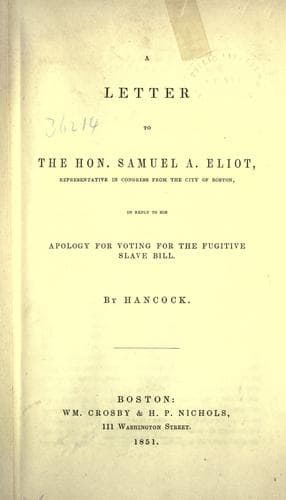
A Letter to the Hon. Samuel A. Eliot, Representative in Congress From the City of Boston, In Reply to His Apology For Voting For the Fugitive Slave Bill.Dexter, Franklin
Philosophy
A Letter to the Hon. Samuel A. Eliot, Representative in Congress From the City of Boston, In Reply to His Apology For Voting For the Fugitive Slave Bill.
Dexter, Franklin
Eliot, Samuel Atkins, 1798-1862; Fugitive slave law of 1850; Slavery -- United States
By some means, the arrest became known, and counsel appeared for the
prisoner. Your commissioner was informed that the prisoner had only been
seized an hour and a half before, and had not heard the charge against
him; that his counsel had had no time to learn the plaintiff's case, nor
to prepare for the defence; that there were persons residing at a
distance, some in New Jersey and some in Wilmington, who would be
important witnesses in his behalf. On these grounds, a motion was made
for a continuance. And what, Sir, do you suppose was the reply made by
the slave-catching judge to this motion? "THE HEARING IS TO BE A SUMMARY
ONE: LET IT PROCEED." No doubt you fully participate in Mr. Webster's
indignation against Austrian barbarity; but see no barbarity in this
accursed proceeding against a _colored_ American. The hearing did
proceed, and James S. Price, on behalf of the plaintiff, swore that the
prisoner was Emery Rice, the man claimed, but knew nothing further about
his being a slave, except that he had seen him riding the claimant's
horse. Had _heard it said_ the prisoner was a slave. This was the amount
of the testimony on behalf of the claimant. Any honest jury, nay, any
honest judge, would instantly have decided in favor of the prisoner.
Not so MR. EDWARD D. INGRAHAM. The counsel for the defendant asked again
for a postponement, and founded the motion on the _oath_ of the
defendant, that he could procure six persons, naming them, to testify to
his freedom. A delay of ONE HOUR was asked for. This was refused, and
the judge(!) sent for a certificate to sign. During the delay thus
occasioned, one of the six persons named by the defendant appeared, and
swore that he had known the prisoner all his life. That he was not Emery
Rice, but Adam Gibson; that he was a freeman, having been manumitted by
the will of his late master. Mr. Brown produced a copy of the will of
the late master, and it so far confirmed the testimony of the witness.
Another person in the crowd now came forward, and swore that he also
knew the prisoner, and that he was a free person, and that he was Adam
Gibson. But all was in vain. The commissioner signed the certificate,
and, with an obtuseness of intellect which marked him as a fit subject
for a commission of lunacy, declared, "He had no doubt of the identity
of the prisoner with the slave Emery Rice, and that _all other
proceedings must be before the courts of Maryland_, whither he would
send him."[1] And so the prisoner, without seeing his wife and children,
whom he had that morning parted from unsuspicious of danger and
unconscious of crime, was hurried off at the expense of our glorious
model republic, under an escort of officers, who delivered him, not to
the courts of Maryland, but to Mr. William S. Knight, the reputed owner.
But Mr. Knight told the officers, "You have brought me a wrong man; this
is not Emery Rice; this man is no slave of mine." And so Adam Gibson
Public-domain text, read in full here on John Shaqi.
Reviews
Reviews
No reviews yet
Be the first to share your thoughts on this work.
Join the Discussion
Join the discussion
Sign in to leave a comment or review.
Sign InorCreate an account