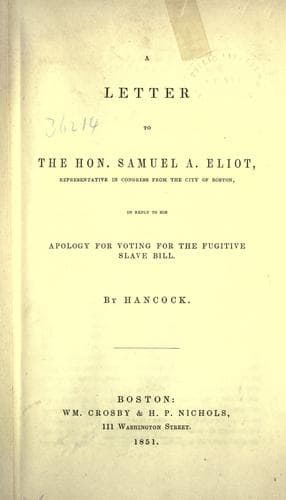
A Letter to the Hon. Samuel A. Eliot, Representative in Congress From the City of Boston, In Reply to His Apology For Voting For the Fugitive Slave Bill. — John Shaqi
A Letter to the Hon. Samuel A. Eliot, Representative in Congress From the City of Boston, In Reply to His Apology For Voting For the Fugitive Slave Bill.Dexter, Franklin
Philosophy
A Letter to the Hon. Samuel A. Eliot, Representative in Congress From the City of Boston, In Reply to His Apology For Voting For the Fugitive Slave Bill.
Dexter, Franklin
Eliot, Samuel Atkins, 1798-1862; Fugitive slave law of 1850; Slavery -- United States
returned to Philadelphia, and is now a living illustration of the
abominable iniquity of one of the most accursed laws to be found in the
statute-book of any civilized nation.
[1] See report in the _New York Tribune_, 25th December, 1850.
You do not think your law more barbarous than that of 1793. Let me
further enlighten you. Judge McLean of the Supreme Court, in his opinion
delivered last May in the case of _Norris_ v. _Newton et al._,
remarks,--"In regard to the arrest of fugitives from labor, the law [act
of 1793] _does not impose any active duties on our citizens generally_";
and he argues in defence of the law, that "it gives no one a just right
to complain; he has only to refrain from an express violation of the
law." In other words, the law only required individuals to be passive
spectators of a horrible outrage, and did not compel them to be active
participators in other men's villany. Now, what says your law? Why, that
every commissioner may appoint as many official slave-catchers as he
pleases, and that each of these menials may "summon and call to their
aid the _by-standers_ or _posse comitatus_ of the proper county, when
necessary to insure a faithful observance of the clause of the
Constitution referred to in conformity with the provisions of this act,
AND ALL GOOD CITIZENS ARE HEREBY COMMANDED TO AID AND ASSIST in the
prompt and efficient execution of this law, whenever their services may
be required." And what is the fate you have provided for the "good
citizen," who, believing slavery to be sinful, cannot, in the fear of
God, "aid and assist" in making a fellow-man a slave? Any person "who
shall aid, abet, or assist" the fugitive "directly or indirectly"
(cunning words) to escape from such claimant, as, for instance, refusing
to join in a slave-hunt when required, shall be fined not exceeding
$1,000, be imprisoned six months, and pay the claimant $1,000. I hope,
Sir, you are now able to perceive that your law has a preeminence in
barbarity over its predecessor. And now, Sir, please to recollect, that
party discipline, aided by the influence of Messrs. Webster and Clay,
and the factory and cotton interest of Boston and New York, could not
procure for this atrocious law the votes of _one half_ the members of
the House of Representatives. Of two hundred and thirty-two members,
only one hundred and nine dared to place their names on an enduring and
shameful record, while many basely deserted their seats, fearing alike
to vote either for or against it. You, Sir, following Mr. Webster's
advice, "conquered your prejudices," and in company with _two_ more
Northern Whigs, one of them a native of Virginia, cast your vote for
this bill of abominations. But, although you voted for the law, you do
not wish your constituents to suppose you approved of it. "It will not,
I trust, be inferred from any thing I have said, that I consider the law
which has passed unexceptionable. There are amendments which I strongly
Public-domain text, read in full here on John Shaqi.
Reviews
Reviews
No reviews yet
Be the first to share your thoughts on this work.
Join the Discussion
Join the discussion
Sign in to leave a comment or review.
Sign InorCreate an account