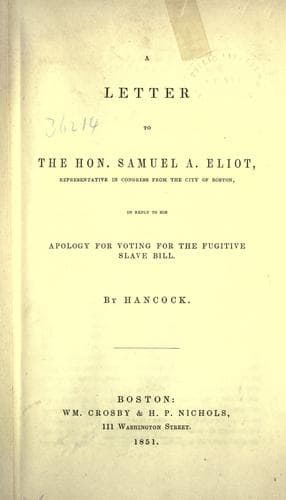
A Letter to the Hon. Samuel A. Eliot, Representative in Congress From the City of Boston, In Reply to His Apology For Voting For the Fugitive Slave Bill.Dexter, Franklin
Philosophy
A Letter to the Hon. Samuel A. Eliot, Representative in Congress From the City of Boston, In Reply to His Apology For Voting For the Fugitive Slave Bill.
Dexter, Franklin
Eliot, Samuel Atkins, 1798-1862; Fugitive slave law of 1850; Slavery -- United States
In former years, and before Mr. Webster had undergone his metamorphosis,
he thus, in a speech at New York, expressed himself in regard to the
antislavery agitation at the North. "It [slavery] has arrested the
_religious feeling_ of the country; it has taken strong hold of the
consciences of men. He is a rash man indeed, little conversant with
human nature, and especially has he a very erroneous estimate of the
character of the people of this country, who supposes that a feeling of
this kind is _to be trifled with or despised_." This gentleman has
become the rash man shadowed forth in his speech, and is trifling with
and despising the religious feeling of the North. In his street speech
in Boston, in favor of slave-hunting, he avowed that he was well aware
that the return of fugitives "is a topic that must excite prejudices,"
and that the question for Massachusetts to decide was, "whether she will
conquer her own prejudice." In his letter to the citizens of
Newburyport, he sneeringly alludes to the "cry that there is a rule for
the government of public men and private men which is superior to the
Constitution," and he scornfully intimates that Mr. Horace Mann, who had
objected to your law as wicked, would do well "to appeal at once, as
others do, to that high authority which sits enthroned above the
Constitution and the laws"; and he gives an extract from a nameless
English correspondent, in which the writer remarks, "Religion is an
excellent thing except in politics," a maxim exceedingly palatable to
very many of our politicians. Aware that the impiety of this sentiment
was not exactly suited to the meridian of Massachusetts, he says his
friend undoubtedly meant "a fantastical notion of religion." Of course,
he regards the religious prejudice against hunting and enslaving men as
springing from a fantastic notion of religion. Yet, with a strange
fatuity, he confesses that "the teaching of Christ and his Apostles is a
sure guide to duty in _politics_, as in any other concern of life,"
utterly oblivious of the fact, that the "higher law," which he
ridicules, was proclaimed in that very teaching. Christ taught, "Fear
not them [magistrates] who kill the body, but are not able to kill the
soul, but rather fear HIM who is able to destroy both soul and body in
hell." What taught the Apostles? "We must obey God, rather than man."
Such teaching it was, that gave birth to "the noble army of martyrs,"
and this very teaching will induce multitudes of Christians at the
present day to hazard fines and imprisonment rather than obey the wicked
injunctions of your law. It was this same teaching which, on the
publication of your law, induced numerous ministers of Jesus Christ, and
various ecclesiastical assemblies, to denounce it as wicked, and
obedience to it as rebellion against God. This expression of religious
sentiment alarmed both our politicians and our merchants. How could the
one expect Southern votes, or the other Southern trade, if the religious
Public-domain text, read in full here on John Shaqi.
Reviews
Reviews
No reviews yet
Be the first to share your thoughts on this work.
Join the Discussion
Join the discussion
Sign in to leave a comment or review.
Sign InorCreate an account