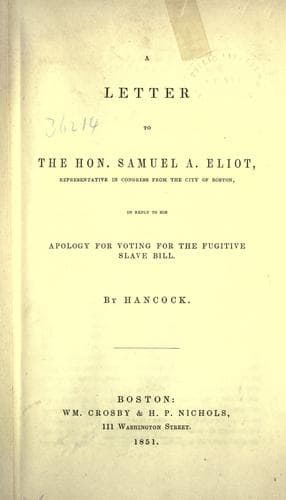
A Letter to the Hon. Samuel A. Eliot, Representative in Congress From the City of Boston, In Reply to His Apology For Voting For the Fugitive Slave Bill. — John Shaqi
A Letter to the Hon. Samuel A. Eliot, Representative in Congress From the City of Boston, In Reply to His Apology For Voting For the Fugitive Slave Bill.Dexter, Franklin
Philosophy
A Letter to the Hon. Samuel A. Eliot, Representative in Congress From the City of Boston, In Reply to His Apology For Voting For the Fugitive Slave Bill.
Dexter, Franklin
Eliot, Samuel Atkins, 1798-1862; Fugitive slave law of 1850; Slavery -- United States
desire to be introduced into it." What are the exceptionable features of
the law, what are the amendments you desire, you refrain from
specifying. But you tell us that you would have labored for these
amendments "had it been possible, but every body knows that it was
_impracticable_." You allude to the _previous question_, which prevented
both discussion and amendments. But why, then, did you vote for an
objectionable bill which could not be amended? Here, again, we have one
of your unfortunate reasons. "I deem conformity to the design of the
Constitution more important than the objectionable details of the bill."
So, by your own confession, had there been no previous question, you
would have swallowed the bill with all its objectionable details, out of
reverence for the _design_ of the Constitution, although that design
neither embraced nor required a single one of those details. Did you,
Sir, vote _against_ the previous question? On this point you are silent,
and the minutes afford no information; but _if_ you did, your vote was a
most remarkable aberration from your proslavery course in Congress.
_After_ the previous question had been seconded, it was moved to lay the
bill on the table. Had this motion been carried, you might have
introduced another bill, omitting the "objectionable details," but you
voted with the slaveholders. The slaveholders then moved that the bill
be read a third time. Had this been lost, there would have been a chance
of correcting the "objectionable details." Again you voted with the
slaveholders, and a third time, also, on the main question.
I will now, Sir, call your attention to the disastrous influence which
your law has exerted on the _moral sense_ of the community. Says
Coleridge, "To dogmatize a crime, that is, to teach it as a doctrine, is
itself a crime." Of this crime of dogmatizing crime, Mr. Webster, and
most of our cotton politicians, and, alas! many of our fashionable,
genteel divines, are guilty; nor are you innocent, Sir, who in your law
require "GOOD citizens" to aid in hunting and enslaving their
fellow-men.
Public-domain text, read in full here on John Shaqi.
Reviews
Reviews
No reviews yet
Be the first to share your thoughts on this work.
Join the Discussion
Join the discussion
Sign in to leave a comment or review.
Sign InorCreate an account