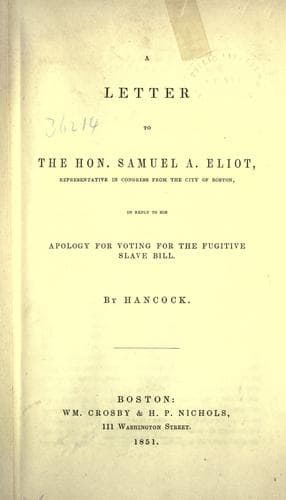
A Letter to the Hon. Samuel A. Eliot, Representative in Congress From the City of Boston, In Reply to His Apology For Voting For the Fugitive Slave Bill.Dexter, Franklin
Philosophy
A Letter to the Hon. Samuel A. Eliot, Representative in Congress From the City of Boston, In Reply to His Apology For Voting For the Fugitive Slave Bill.
Dexter, Franklin
Eliot, Samuel Atkins, 1798-1862; Fugitive slave law of 1850; Slavery -- United States
But lately, the business of catching slaves was regarded as one of the
lowest grades of scoundrelism. Now, great pains are taken by our
gentlemen of property and standing to ennoble it; and men of eminence in
the legal profession are stooping to take the wages of iniquity, and
lending themselves to consign to the horrors of American slavery men
whom they know to be innocent of crime. Nay, we have seen in New York a
committee of gentlemen actually _raising money by voluntary
contribution_ to furnish a slave-catcher with professional services
gratis;--a free gift, not to mitigate human misery, but to aggravate the
hardships of the poor and friendless a thousandfold. Can men of standing
in the community thus openly espouse the cause of cruelty and
oppression, and, from commercial and political views, trample upon every
principle of Christian benevolence, without corrupting the moral sense
of the people to the extent of their influence? When gentlemen club
together to hire a lawyer to assist a slave-catcher, no wonder that the
commercial press should teem with the vilest abuse of all who feel
sympathy for the fugitive. One of the most malignant proslavery journals
in New York is edited by your colleague and fellow-Whig, the Honorable
Mr. Brooks, and his brother. I copy, Sir, for your consideration, the
following article from the _New York Evening Express_, published during
the late trial in that city of Henry Long, an alleged fugitive:--
"Two fugitive cases are now before our courts; one that of the negro
Henry Long, and the other that of three white Frenchmen, under the
extradition treaty with France. The negro's case makes a great deal of
noise, because he is black; the three white Frenchmen are hardly heard
of. The three white French people pay their own counsel: they may have
committed a robbery in Paris, or may not; are perhaps innocent, though
possibly guilty; but here they are on trial, with no chance of a trial
before a jury! If they are sent back, and are convicted, they go to the
galleys, and are slaves for life. The negro, Henry Long, lucky fellow
for being black! lives in clover here, and has one of the best speakers
in the city, on the best fee, interests all the Abolitionists in all
quarters, who contribute money freely for his defence, and if he is
returned, leaves here canonized as a martyr, and goes back to the
condition he was born in, to fatten on hog and hominy, better fed and
better clothed than nine tenths of the farm laborers in Great Britain.
Another consideration strikes us, and that is, the cost of defending
Long will buy his freedom three times over. The very fee of his counsel
would purchase his freedom. But to buy him and pay for him, _not steal_
him, would leave no room for agitation. And where does this money come
from, that cares for Long and neglects the three Frenchmen? From
England, in the main, we believe. The Abolitionists here do not
_contribute it_."
Public-domain text, read in full here on John Shaqi.
Reviews
Reviews
No reviews yet
Be the first to share your thoughts on this work.
Join the Discussion
Join the discussion
Sign in to leave a comment or review.
Sign InorCreate an account