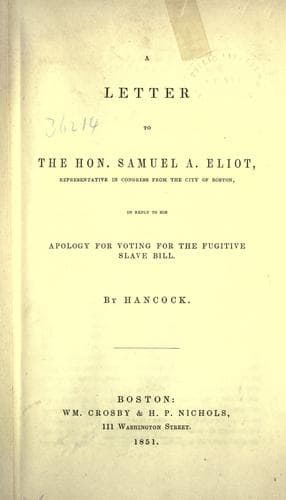
A Letter to the Hon. Samuel A. Eliot, Representative in Congress From the City of Boston, In Reply to His Apology For Voting For the Fugitive Slave Bill.Dexter, Franklin
Philosophy
A Letter to the Hon. Samuel A. Eliot, Representative in Congress From the City of Boston, In Reply to His Apology For Voting For the Fugitive Slave Bill.
Dexter, Franklin
Eliot, Samuel Atkins, 1798-1862; Fugitive slave law of 1850; Slavery -- United States
It would be difficult to find in the Satanic press a more clumsy piece
of malignant falsehood. We have here, from the same pen, and in the same
article, the assertions, that the Abolitionists, in all quarters, we are
assured, "contribute money freely for his defence"; and then the money,
it is believed, comes mainly from England. "The Abolitionists here do
not contribute it." To contribute money for the legal defence of a
fugitive is _stealing him_. The cost of defending Long amounted to three
times the price that would be asked for him. Long, after his return,
sold in Richmond for $750; of course his defence cost $2,250. To whom,
and for what, was this money paid? Long could not be bought in New York,
all advances for the purpose being peremptorily repulsed. His counsel's
fee was $300, being all contributed in New York, and about $100 of it
being raised by the free colored people. While $300 were thus raised to
give Long the chance of a legal defence, gentlemen of the New York Union
Safety Committee, of which your colleague has the honor of being a
member, contributed $500 to aid the slave-catcher in reducing to bondage
a man unaccused of crime!
I am inclined to believe, Sir, that you have little cause to
congratulate yourself, that, in voting for the Fugitive Slave Law, you
have advanced the cause of truth, justice, humanity, or religion.
A refusal to _obey_ your wicked law has been artfully represented as a
determination to _resist_ its execution. Very few of our white
population have intimated the most distant intention of resorting to
illegal violence. Very many ecclesiastical bodies have denounced your
law as so iniquitous, that they could not in conscience obey it; but I
challenge you to point to a _single instance_ in which such a body has
recommended forcible resistance. To the vast accumulation of impiety
uttered in support of your law has been added a fiendish ridicule of the
benevolent and Christian feeling arrayed against it. It is true, that
some of our free blacks and fugitives have declared, that they would, at
the hazard of their lives, defend themselves against the kidnapper.
Whatever may be thought of the wisdom of such a determination, be
assured it will tax your logical powers to the utmost to prove that God
has conferred the right of self-defence exclusively upon white men. The
slave is a prisoner of war, and instead of being protected by law, he is
subjected by it to every conceivable outrage. When murdered, his owner
seeks in the courts _damages_ at the hands of the murderer, as he would
for the death of his horse. For no possible injury committed on his
person, either by his owner or others, can he receive compensation,
although the law may profess to punish cruelty to him as to other
animals. Now it has never been regarded as immoral, by those who admit
the right of self-defence, for a prisoner of war to effect his escape by
slaying his guard. All this, I know, will horrify a certain class of
Public-domain text, read in full here on John Shaqi.
Reviews
Reviews
No reviews yet
Be the first to share your thoughts on this work.
Join the Discussion
Join the discussion
Sign in to leave a comment or review.
Sign InorCreate an account