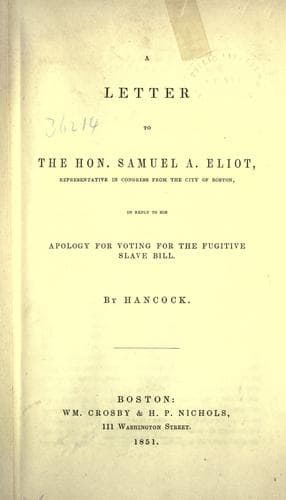
A Letter to the Hon. Samuel A. Eliot, Representative in Congress From the City of Boston, In Reply to His Apology For Voting For the Fugitive Slave Bill. — John Shaqi
A Letter to the Hon. Samuel A. Eliot, Representative in Congress From the City of Boston, In Reply to His Apology For Voting For the Fugitive Slave Bill.Dexter, Franklin
Philosophy
A Letter to the Hon. Samuel A. Eliot, Representative in Congress From the City of Boston, In Reply to His Apology For Voting For the Fugitive Slave Bill.
Dexter, Franklin
Eliot, Samuel Atkins, 1798-1862; Fugitive slave law of 1850; Slavery -- United States
our divines and politicians. But let them be patient. I am not laying
down a doctrine, but stating _facts_, which they may disprove if they
can. Let them remember, that all the slavery which they delight to find
in the Bible was the slavery of _white_ men, and that the Roman slaves
in the time of Christ, whose bondage, we are told, he and his Apostles
approved, were held by the _right of war_. White Americans have been
held as slaves by the same holy and Scriptural tenure. Let us, then,
inquire how the escape and resistance of white slaves have heretofore
been regarded. In 1535, the _white_ slaves in Tunis alone amounted to
twenty thousand. Cervantes, who had himself been a slave in Algiers,
says in his writings, "For liberty we ought to risk life itself; slavery
being the greatest evil that can fall to the lot of man." Acting upon
this precept, he himself, while a slave, planned a general insurrection
of the slaves. Yet Cervantes was recognized as a faithful son of the
Church, and the license prefixed to his works declares they contain
nothing contrary to the Christian religion. The Annual Register for 1763
announces, that, "last month, the Christian slaves at Algiers, to the
number of four thousand, rose and killed their guards, and massacred all
who came in their way." The insurrection was suppressed, but no one in
Europe denounced the insurgents as bloodthirsty wretches, nor regarded
their effort as an impious and anti-Christian rebellion against the
powers ordained of God. In the reign of Elizabeth, one John Fox, a slave
on the Barbary coast, slew his master, and, effecting his escape with a
number of his fellow-slaves, arrived in England. The queen, instead of
looking upon him as a murderer, testified her admiration of his exploit
by allowing him a pension.[3]
[3] For the facts on this subject, see the admirable work by Charles
Sumner, entitled "White Slavery in the Barbary States."
Washington Madison performed a similar exploit on board an American
coast slaver, and arrived, with a large number of his fellow-slaves, in
the British West Indies. Mr. Webster, then Secretary of State,
officially demanded of the British government the surrender of this
heroic man as a MURDERER.
In 1793, there were one hundred and fifteen American slaves in Algiers,
held by as perfect and Scriptural a tenure as any slave is now held in
any part of our wide republic. Had one of these slaves made his escape
by killing his Algerine master, would any of our patriotic divines,
would any gentleman of the "New York Union Committee of Safety," would
even Mr. Webster himself, have pronounced him a murderer? Had the
captain of a British ship favored his escape, and given him a passage to
Boston, would your colleague, the Honorable Mr. Brooks, have accused him
of slave-stealing? Is it not possible, Sir, that, with very many of our
casuists and moralists, questions of conscience are decided according to
the tincture of a skin?
Public-domain text, read in full here on John Shaqi.
Reviews
Reviews
No reviews yet
Be the first to share your thoughts on this work.
Join the Discussion
Join the discussion
Sign in to leave a comment or review.
Sign InorCreate an account