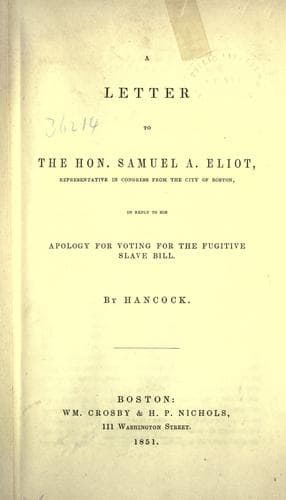
A Letter to the Hon. Samuel A. Eliot, Representative in Congress From the City of Boston, In Reply to His Apology For Voting For the Fugitive Slave Bill.Dexter, Franklin
Philosophy
A Letter to the Hon. Samuel A. Eliot, Representative in Congress From the City of Boston, In Reply to His Apology For Voting For the Fugitive Slave Bill.
Dexter, Franklin
Eliot, Samuel Atkins, 1798-1862; Fugitive slave law of 1850; Slavery -- United States
Thus we learn from you, Sir, that when the Constitution was formed,
"slavery had been abolished in some of the States." It is a pity you did
not vouchsafe to tell us which of the States had thus early and
honorably distinguished themselves. Of the thirteen American States in
1787, how many, Sir, had _by law_ abolished slavery? NOT ONE. Your "some
States" consisted of MASSACHUSETTS alone. And how was slavery abolished
there? Not by any express prohibition in her constitution, nor by any
act of her legislature. Fortunately, her constitution, like that of most
other States, contained a general declaration of human rights, somewhat
similar to the "rhetorical abstraction" in the Declaration of
Independence. Two or three years before the Federal Convention
assembled, a young lawyer, perceiving that the declaration in the
constitution had inadvertently made no exclusion of the rights of men
with dark complexions, brought an action for a slave against his master
for work done and performed. An upright and independent court, not
having the fear of our Southern brethren before their eyes, decided that
the slave was a MAN, and therefore entitled to the rights which the
constitution declared belonged to _all_ men, and gave judgment for the
plaintiff. In this way, Sir, was slavery abolished in Massachusetts, and
hence the delegates from Massachusetts in the Convention were the only
ones who represented a _free_ State. And now, Sir, what becomes of your
"insurmountable incompatibility of interests" arising from the fact that
"slavery had been abolished in some States and still existed in others,"
which you tell us so much perplexed the wise men of that day? We shall
see, Sir, that on questions touching human bondage the Massachusetts
delegation seem to have been slaveholders in heart, and did not partake
of the perplexity which troubled the wise men. With the exception of
that delegation, there were not probably half a dozen members of the
convention who were not slaveholders.
It would seem from your historical review, that the clause in the
Constitution respecting fugitive slaves was the grand compromise
between the North and the South, without which "the Constitution could
not have been adopted"; and that to this clause we owe our glorious
slave-catching Union. You fortify this wonderful historical discovery by
appealing to the "deliberate declarations" of Southern members, that
they "would not enter a union with States who would tempt away their
slaves," &c. It is to be regretted that you have not deemed it expedient
to refer to the records of these declarations, as other students of our
constitutional history are wholly ignorant of them. Suffer me, Sir, to
enter into a few historical details, for the purpose of vindicating the
liberty I take to differ with you as to the accuracy of your statements.
Public-domain text, read in full here on John Shaqi.
Reviews
Reviews
No reviews yet
Be the first to share your thoughts on this work.
Join the Discussion
Join the discussion
Sign in to leave a comment or review.
Sign InorCreate an account