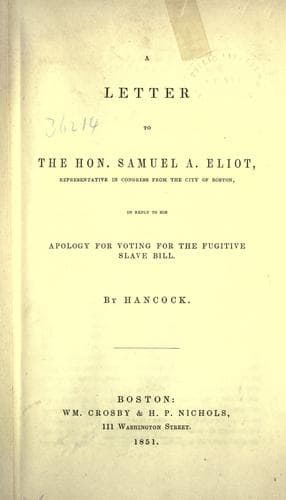
A Letter to the Hon. Samuel A. Eliot, Representative in Congress From the City of Boston, In Reply to His Apology For Voting For the Fugitive Slave Bill. — John Shaqi
A Letter to the Hon. Samuel A. Eliot, Representative in Congress From the City of Boston, In Reply to His Apology For Voting For the Fugitive Slave Bill.Dexter, Franklin
Philosophy
A Letter to the Hon. Samuel A. Eliot, Representative in Congress From the City of Boston, In Reply to His Apology For Voting For the Fugitive Slave Bill.
Dexter, Franklin
Eliot, Samuel Atkins, 1798-1862; Fugitive slave law of 1850; Slavery -- United States
The Convention met in Philadelphia, 25th May, 1787. On the 29th of the
same month, Mr. Randolph, of Virginia, submitted a plan of government.
It contained no allusion to fugitive slaves. On the same day, Mr.
Charles Pinckney, of South Carolina, submitted another plan. This last
provided for the surrender of fugitive criminals, but was silent about
fugitive slaves. On the 15th of June, Mr. Patterson, of New Jersey,
submitted a third plan. This also provided for the surrender of
fugitives from justice, but not from bondage. On the 18th, Mr. Hamilton
announced his plan, but the fugitive slave found no place in it. On the
26th of June, the Convention, having agreed on the general features of
the proposed Constitution in the form of resolutions, referred them to
"a committee of detail," for the purpose of reducing them to the form of
a Constitution. In these resolutions, there was not the most distant
allusion to fugitive slaves. On the 6th of August, the committee
reported the draft of a Constitution, and yet, strange as you may deem
it, the provision without which, you tell us, the Constitution could not
have been adopted, was not in it, although there was in it a provision
for the surrender of fugitive criminals. For three months had the
Convention been in session, and not one syllable had been uttered about
fugitive slaves. At last, on the 29th of August, as we learn from the
minutes, "It was moved and seconded to agree to the following
proposition, to be inserted after the 15th article: 'If any person,
bound to service or labor in any of the United States, shall escape into
another State, he or she shall not be discharged from such service or
labor in consequence of any regulation subsisting in the State to which
they escape, but shall be delivered up to the person justly claiming
their service or labor,' _which passed unanimously_." Really, Sir, I
find in this record but little evidence of the perplexity which
distressed our wise men, or of the great compromise between the North
and South, on which you dwell. The 15th article, referred to above, was
the article providing for the surrender of fugitives from justice, and
this suggested the idea, that it would be well to provide, also, for the
surrender of fugitive slaves. In an assembly consisting almost
exclusively of slaveholders, the idea was exceedingly relished; and
without a word of opposition, the suggestion was unanimously adopted.
From Mr. Madison's report we learn that, the day before, Messrs. Butler
and Pinckney had informally proposed that fugitive slaves and servants
should be delivered up "like criminals." "Mr. Wilson [of Penn.]. This
would oblige the Executive of the State to do it at the public expense.
Mr. Sherman [of Conn.] saw no more propriety in the public seizing and
surrendering a slave or servant than a horse." (_Madison Papers_, p.
1447.) The subject was here dropped. The next day the motion was made in
form, and, as Mr. Madison says, "agreed to, _nem. con._" From the
Public-domain text, read in full here on John Shaqi.
Reviews
Reviews
No reviews yet
Be the first to share your thoughts on this work.
Join the Discussion
Join the discussion
Sign in to leave a comment or review.
Sign InorCreate an account