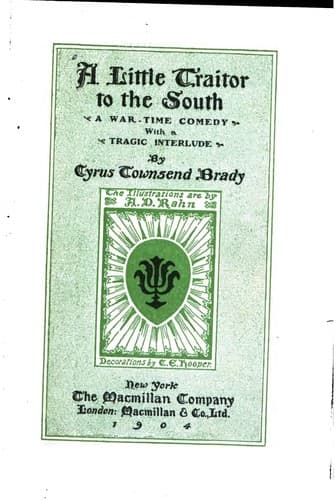
A Little Traitor to the South: A War Time Comedy with a Tragic InterludeBrady, Cyrus Townsend
History
A Little Traitor to the South: A War Time Comedy with a Tragic Interlude
Brady, Cyrus Townsend
United States -- History -- Civil War, 1861-1865 -- Fiction
Yet--she had disgraced him, dishonored him! That was not the act of a
loving woman. She had shown herself possessed of a full measure of
womanly heroism and courage. She knew exactly what was involved in his
failure to carry out his orders. How could she have done it? Was it all
acting then? Did her kisses betray him? Was she indeed a traitor--and
to him? Yet--for whom?
There was Lacy--oh, had he repented after all? Had he wished to resume
the command he had so reluctantly surrendered? Had she been a party to
any plan whereby the matter might be brought about? Was he to be shamed
and sacrificed for Lacy's glory and honor by this woman? Perish the
thought! Yet why had she fainted on the wharf? Was it at the mention of
Lacy's name? Was she alarmed for his safety? If that were the case, why
had she not striven to restrain Lacy and allowed him to go in his
place?
Suddenly there flashed into his mind that there might be some one on
the _Wabash_ whom she wished to protect! Could that be the solution of
the mystery? No one knew anything of her origin, her past history. Was
she faithful to the South, yet had she a--a--lover in the Union fleet?
Was she indeed what he called her, a heartless coquette? He could have
sworn from that brief moment when he held her in his arms, when he
looked at her, that she loved him. She had returned his kiss. Oh, had
she? Was it a dream? A play? To deceive him? Great God! was he going
mad?
Of only one thing was he certain. He could never disclose to any one
the cause of his failure to present himself on the wharf in time.
Whether she loved Lacy, or some one in the Union fleet, made no
difference to his love. He would love her till he died. Ay, he would
love her even in the face of her treachery, her faithlessness--everything!
He hated himself for this, but it was true, he could not deny it.
And he would save her from the consequences of her action at the cost
of his life--his honor even. What had he to live for anyway, if she
were taken from him? Death might come. It would come. He would make no
defence. It was quite within the power of a court-martial to order him
shot. And it was quite within the power of a court-martial to punish
Fanny Glen, too, if he fastened the culpability for his failure upon
her; perhaps not by death, but certainly by disgrace and shame. The
city was under martial rule, General Beauregard was supreme. No, he
could not expose her to that condemnation--he loved her too well.
Yet he wished that he could hate her, as he paced up and down the long
room, stopping at the windows to stare out into the dark in the
direction of the sea--where he should have been if all had gone well.
Public-domain text, read in full here on John Shaqi.
Reviews
Reviews
No reviews yet
Be the first to share your thoughts on this work.
Join the Discussion
Join the discussion
Sign in to leave a comment or review.
Sign InorCreate an account