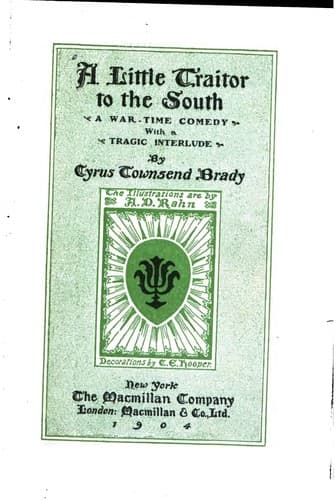
A Little Traitor to the South: A War Time Comedy with a Tragic Interlude — John Shaqi
A Little Traitor to the South: A War Time Comedy with a Tragic InterludeBrady, Cyrus Townsend
History
A Little Traitor to the South: A War Time Comedy with a Tragic Interlude
Brady, Cyrus Townsend
United States -- History -- Civil War, 1861-1865 -- Fiction
He was too far away to hear the explosion of the torpedo, which was
muffled, because it took place under water, but he could hear the
batteries of the ships as they opened on the blockade-runners, and the
answer from the forts, and he knew that something had happened at any
rate. And his suspense as to that added to his wretchedness. Lacy had
supplanted him and reaped the glory--again. It was maddening. No one
came to bring him any word. The general concluded to postpone his
inquiry until the next morning, and Sempland paced the floor the night
long in a pitiable condition of wounded love, blasted hope, shattered
fame.
At home, not far away, poor Fanny Glen was even more miserable than
Rhett Sempland, for she had divined--yes, so soon as the two men had
left her presence the afternoon before, she had recognized the
fact--that she loved Sempland. Conviction had grown upon her swiftly,
and in those moments when she was fearful that he would succeed in his
purpose, when she had kept him a prisoner in her home to prevent him
from taking out the _David_ to try to blow up the _Wabash_, she knew
that she loved him.
When he had held her in his arms in that bold and successful effort to
escape, when he had strained her to his breast, when he had kissed
her--oh, that kiss!--the consciousness of her passion overwhelmed her.
The recollection of it even filled her with passionate tenderness. She
had not been afraid when he had threatened her with the pistol. She
could have died easily then--in his arms, with his kiss upon her lips,
his heart beating against her own. He loved her! Nothing else mattered
for the moment.
She had endeavored to keep him a prisoner partly for his own sake, but
principally for another and greater reason. She had not thought of
disgrace or shame to him. It had all come so swiftly. She had no time
to reflect at all. She had decided upon impulse, with but one thought
at first--to save the Union ship. In her sudden alarm and anxiety she
had not realized that she was playing a traitor's part. Or if she had,
she had done it willingly, in the belief that the punishment would fall
upon her, and that he would be held blameless.
But for whatever reason she had acted as she had, she had failed after
all, for another had taken Sempland's part, and the flagship, if the
_David_ succeeded, was doomed. Her sacrifice was unavailing. She had
lost everything. Sempland had shrunk away from her when she had
confronted him and the general on the wharf, and when she had recovered
consciousness he was gone. She could not know his heart had gone out to
her lying there, nor how they had hurried him away from her prostrate
figure.
Public-domain text, read in full here on John Shaqi.
Reviews
Reviews
No reviews yet
Be the first to share your thoughts on this work.
Join the Discussion
Join the discussion
Sign in to leave a comment or review.
Sign InorCreate an account