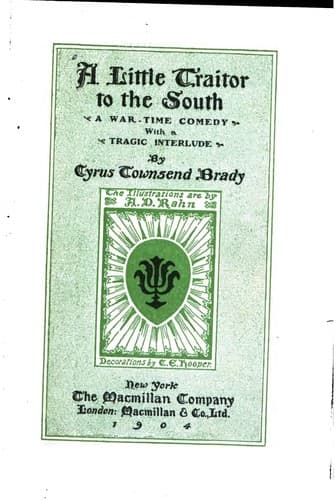
A Little Traitor to the South: A War Time Comedy with a Tragic InterludeBrady, Cyrus Townsend
History
A Little Traitor to the South: A War Time Comedy with a Tragic Interlude
Brady, Cyrus Townsend
United States -- History -- Civil War, 1861-1865 -- Fiction
"That doesn't excuse him," said the general, severely. "Any man who
fails in his duty because he succumbs to a woman's wiles, even though
that woman loves him, has no plea to urge in justification. He is a
soldier. His duty to obey orders is first of all."
"But--but--you don't understand. I--I--kept him there by force, sir.
Major Lacy told me of the expedition--he and Mr. Sempland had called
upon me in the afternoon. They--they had each of them asked
me--in--marriage. We--we quarrelled. Mr. Sempland left me in anger,
Major Lacy divined that I--I--cared for Mr. Sempland. He came back
later in the evening and told me Mr. Sempland was going to blow up the
_Wabash_, and he begged me to see Mr. Sempland again and bid him
good-by. I had only two thoughts--that it meant certain death to my
father and possibly Mr. Sempland--the man--I--What was I to do? I might
have sacrificed myself by letting Mr. Sempland run the risk, but my
father, sir--"
She stopped and looked at him in pitiful entreaty.
"Go on," said the general, inflexibly.
"I had Mr. Sempland ushered into the strong room of the house--the old
Rennie house, you know, sir?"
The general nodded.
"The door was locked on him after he entered. My three negro boys kept
watch outside. There was no escape for him. He beat and hammered on the
door until his hands bled. He begged and implored to be released. It
was agonizing to hear. I did not realize that he was telling the truth
when he said he was being dishonored. I had no time to consider
anything. I only thought of my father--helpless on that great ship--the
sudden rush of that awful little boat."
"You were a traitor to the South!" said General Beauregard, coldly.
[Illustration: "'You were a traitor to the South!' said General
Beauregard, coldly."]
"Yes. God pity me, I see it now," answered the girl.
"How did he get away? Did you release him?" continued the general.
"He swore that he would kill himself if I did not open the door."
"Did you open it?"
"Yes."
"Then did he burst through you and the men?"
"No. They were armed and would have killed him. He could not have made
his escape that way. He begged me to speak to him alone for a moment. I
went into the room and shut the door. He seized me in his arms and then
put his pistol to my head, threatening to kill me if I did not order
the door opened."
"And you obeyed?"
"No, I refused. Then he called out to the slaves to open at once or he
would kill me, their mistress."
"What happened then?"
"I ordered them not to open the door, to let me die. But they did as he
said. He made them leave the hall. They obeyed him in spite of my
protests. Then he threw me aside, and ran to the wharf. I followed
after. The rest you know. It was useless after all. I thought no one
would go if he did not. I thought if I could detain him a night--get
some delay--I would come here in the morning and tell you the truth and
ask you to spare my father."
Public-domain text, read in full here on John Shaqi.
Reviews
Reviews
No reviews yet
Be the first to share your thoughts on this work.
Join the Discussion
Join the discussion
Sign in to leave a comment or review.
Sign InorCreate an account