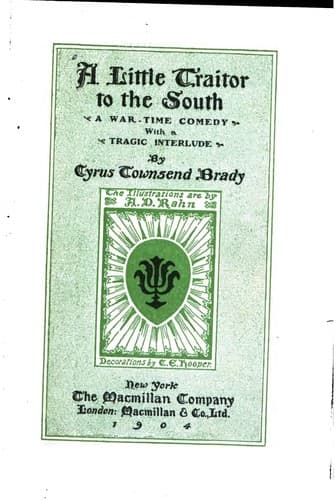
A Little Traitor to the South: A War Time Comedy with a Tragic InterludeBrady, Cyrus Townsend
History
A Little Traitor to the South: A War Time Comedy with a Tragic Interlude
Brady, Cyrus Townsend
United States -- History -- Civil War, 1861-1865 -- Fiction
"Miss Glen," said the little general, "I would not spare my own father
if my duty demanded that he be sacrificed."
"I suppose so. You are a man, you cannot understand. I am a woman.
There were but two I loved on earth. I was ashamed of my father, but I
loved him. Four years of war have taught me other things. I am sorry
that he did not go with the South, but it is not for me to judge him. I
could not see him condemned to death and not raise a hand to save him.
And I discovered too late that I--I--cared for Mr. Sempland. I drove
him from me in scorn and contempt--I taunted him. He sought that detail
to prove his courage, I could not let him go to certain death. If he
did it would be my fault, I would have murdered him. Pity me! I am only
a woman. Try to understand!"
"But the young man has proven his courage--"
"I know, I know! I never doubted it," she interrupted.
"By keeping silent this morning, by facing certain death upon charges
that are worse than the punishment to a soldier, in that they blast his
fame," said the general.
"Thank God for that kindness to me!"
"And he did all this for you."
"He loves me, as I love him."
"But your love has disgraced him, his has protected you."
The girl shrank before the stern words of the soldier.
"Yes," she said faintly, "it is as you say. I alone am to blame. Let
mine alone be the punishment. I will tell all to the court. He must be
cleared!"
"It is just," said Beauregard. "You have committed an act of treason
against the South. There is, however, some excuse for your action, and
your previous record in the hospital service has been such as to
entitle you to every consideration. I am disposed to be lenient, but
the offence is one I cannot condone. I will have to put you under guard
until I can consider what is best to be done."
"I make no protest," said Fanny Glen. "You will, of course, release Mr.
Sempland from arrest, and see that his reputation takes no hurt?"
"I will attend to that."
He struck a bell again and summoned the assistant adjutant-general once
more. Fanny Glen dropped her veil so that her face was concealed from
the officer. He did not perceive what she had suffered and was
suffering. Yet her heart was full of relief--her father was safe, her
lover would be free, and, best of all, she had such testimony as few
women have received to the depth and power of his passion. He loved her
indeed. There was a joy in that thought that set her heart beating.
The general drew his subordinate into a corner of the room, where they
conversed earnestly for a few moments. Then they came back to the young
girl.
"Adjutant-General Wylie," said the commander-in-chief, "you will take
charge of Miss Glen. You will follow him, Miss Glen. I will communicate
my further plans within an hour."
There was something intensely pathetic in the droop of the little
figure, in spite of the comforting thoughts that had come to her, when
the girl rose and followed the soldier from the room.
Public-domain text, read in full here on John Shaqi.
Reviews
Reviews
No reviews yet
Be the first to share your thoughts on this work.
Join the Discussion
Join the discussion
Sign in to leave a comment or review.
Sign InorCreate an account