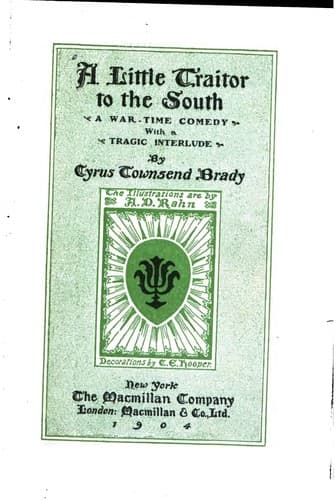
A Little Traitor to the South: A War Time Comedy with a Tragic Interlude — John Shaqi
A Little Traitor to the South: A War Time Comedy with a Tragic InterludeBrady, Cyrus Townsend
History
A Little Traitor to the South: A War Time Comedy with a Tragic Interlude
Brady, Cyrus Townsend
United States -- History -- Civil War, 1861-1865 -- Fiction
He had failed miserably, officially and personally. He decided, against
heart and hope, at last, that he had made no progress in his love
affair. The woman he adored had given him convincing proof, so he
argued, rebellious against the conclusion to the last, that his
professional future was a matter of indifference to her; nay, that his
very life was a thing she would jeopard or even forfeit lightly. Lacy,
as usual, had stepped in the breach and earned immortal fame, even if
he had to die to secure it. Sempland envied him his rest, with his
brave companions in arms in the desperate sea venture, beneath the
cool, green waters of the ocean that laved their beloved shore.
Well, there was no use in worrying or speculating any longer. It would
all be over soon now. He was sufficiently experienced as a soldier to
know what would happen to him. There was only one possible verdict,
only one punishment for the crimes with which he was charged.
When he was sentenced to death, his friends would undoubtedly move
heaven and earth to get President Davis to mitigate or commute his
punishment; but he was resolved in his own mind firmly to discourage
such efforts. He took a gloomy view of life and of love and of
women--do they not always go together in the heart of youth? There was
nothing now, therefore, for which he cared to live.
Yet if he could only see Fanny Glen again! Why did she not send some
one to inquire as to his whereabouts? Surely she might ask after his
welfare. She must know he was under arrest. Why could she not come
herself? He was sacrificing himself for her, to preserve her freedom,
ay, her honor and reputation. She might not love him, but at least she
might have manifested a decent interest in his fate. The barest
politeness ought to make a woman take some thought for a man who was
about to be shot for her sake, he thought bitterly.
Well, he swore to himself, if she should come at the last moment, she
would find him as cold as ice, as indifferent as a Laodicean! He would
show her that he appreciated at its true value not only her heinous
conduct, but her criminal neglect as well. He would make her understand
that it was not love for her that kept him silent. Oh, no! Simply the
obligation of a gentleman, a man of honor, albeit a quixotic one.
Oh, noble resolution! He would go to his grave silent, loading upon her
the weight of an obligation, from which she should never escape. When
the war was over she might marry that man on the _Wabash_ whom she had
been so anxious to save that she had pretended love for him--Sempland!
Yes, he would be under obligation, too, this Union sailor, for to
Sempland would be due his possession of Fanny Glen.
Public-domain text, read in full here on John Shaqi.
Reviews
Reviews
No reviews yet
Be the first to share your thoughts on this work.
Join the Discussion
Join the discussion
Sign in to leave a comment or review.
Sign InorCreate an account