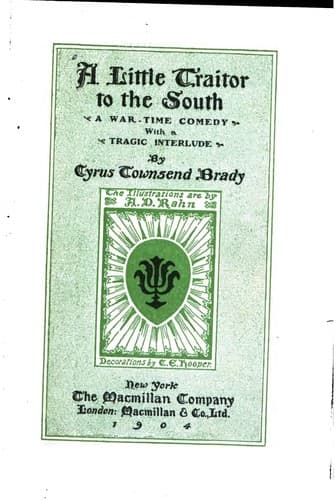
A Little Traitor to the South: A War Time Comedy with a Tragic InterludeBrady, Cyrus Townsend
History
A Little Traitor to the South: A War Time Comedy with a Tragic Interlude
Brady, Cyrus Townsend
United States -- History -- Civil War, 1861-1865 -- Fiction
The general was almost persuaded to call after her a reassuring word or
two, but he restrained himself and said nothing.
CHAPTER XIII
COMPANIONS IN MISERY
It is conceivable that a man could manage to bear without repining the
loss of fame and fortune, that he could survive deprivation of rank and
station with equanimity, nay, more, that he might even contemplate with
a philosophic indifference an impending forfeiture of life, provided he
had love to sustain him. But when that is lost, and consequently
everything is gone, he has to fall back upon conscious rectitude alone,
which is well enough in schemes of philosophy, but most inadequate in
the emergencies and crises of real life.
Lieutenant Rhett Sempland, under arrest, in confinement, awaiting
trial, alone and unvisited by any one,--which meant Fanny Glen,--felt
that morning as if he had indeed lost everything. He had been certain
at first that Fanny Glen had returned his swift, impulsive caress in
the strong room even in the peculiar circumstances under which he had
bestowed it upon her, and he had therefore naturally inferred that she
loved him. Indeed, when he thought of the look in her eyes when he
strained her to his breast, although he had the pistol pointed at her
forehead, the conviction was strong within him.
Yet, again and again this proposition presented itself to him, crushing
his hope and breaking his heart: How could a woman who loved a man, and
a woman especially who had become sufficiently conversant with military
affairs through her hospital service and other experiences in this war
to understand what she was doing, have placed her lover in so
compromising a position?
And most damnably crushing thought of all, why had she not had the
common decency after all to come and see him this morning? He was in
trouble, and he suffered for her sake. She must know that, she must
realize it. Why did she give no sign of it?
His loneliness and his craving to see her was terrible. His desire to
see her grew with every passing moment, he was consumed by it; yet, he
thought bitterly, to what purpose, after all?
Some of this had come to him last night; but the more he thought of it,
the more uncertain, miserable, and deserted he felt. So it is not
strange that it was not so much his own impending fate as it was the
hopeless endeavor to discover the real reason for Fanny Glen's conduct
which engrossed his attention that fateful morning.
Public-domain text, read in full here on John Shaqi.
Reviews
Reviews
No reviews yet
Be the first to share your thoughts on this work.
Join the Discussion
Join the discussion
Sign in to leave a comment or review.
Sign InorCreate an account