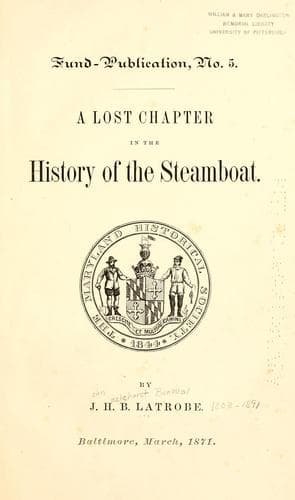
A Lost Chapter in the History of the SteamboatLatrobe, John H. B. (John Hazlehurst Boneval)
History
A Lost Chapter in the History of the Steamboat
Latrobe, John H. B. (John Hazlehurst Boneval)
Roosevelt, Nicholas J., 1767-1854; Steam-navigation -- History
The above were notions, mere notions, all of them—all of them were utter
failures; and the enumeration of them, now, excites our astonishment
that any one of them should have been tried. Long before the day of
Fulton, long before the earliest period to which Fulton, at any time,
ever attempted to carry back the plan of steam navigation, it was, as I
have shewn, entertained and practically experimented on, here in
America, by Fitch, Rumsey, Kensey and others, all of whom failed to
succeed. What made it a success at last? _The use of vertical wheels
over the sides of the vessel._ Why had it not succeeded previously?
_Because vertical wheels were not combined with steam power_ in the
production of the desired result—a successful steamboat, as now
understood. The merit lies with him, therefore, who first suggested the
combination that produced success,—describing it in such a practical
shape that the task of invention was completed, leaving nothing to be
done but the mechanical execution. Was this the merit of Robert Fulton?
Unquestionably it was not; and the object of this writing is to
demonstrate the fact.
I have before me the original “petition of Nicholas J. Roosevelt to the
Honorable the Governor, the Councils and the Representatives, of the
State of New Jersey, in Legislative assembly convened,”—dated January
13th, 1815, in which he “asserts (I quote his words) with the modest and
manly firmness of honesty that he is the true and original inventor and
discoverer of steamboats with vertical wheels now in use.” And he prays
from the Legislature, “as the constitutional guardians of the rights of
their fellow-citizens and of the interests of the State,” such
privileges, as on examination and hearing he may be thought entitled to.
At this time, there were vague notions of the powers of the States over
their navigable waters, which the decision of the Supreme Court, in
connection with the steamboat controversy, dissipated at a later day.
Belonging to an old New York family, whose worth had been illustrated
then, as it has been since, by the honorable positions that its members
have held in that great State, Mr. Roosevelt was a gentleman of
character and education, of an active enterprising temper, and addicted
all his life to matters connected with civil engineering and mechanics.
Appreciated by all who knew him as a person of unblemished honor, his
word was independent of his oath; but, attached to the petition just
referred to is an affidavit, not without interest, of which the
following is an extract:
Public-domain text, read in full here on John Shaqi.
Reviews
Reviews
No reviews yet
Be the first to share your thoughts on this work.
Join the Discussion
Join the discussion
Sign in to leave a comment or review.
Sign InorCreate an account