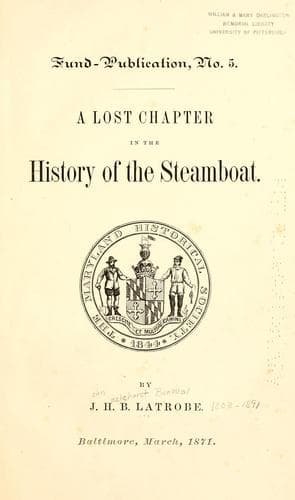
A Lost Chapter in the History of the Steamboat — John Shaqi
A Lost Chapter in the History of the SteamboatLatrobe, John H. B. (John Hazlehurst Boneval)
History
A Lost Chapter in the History of the Steamboat
Latrobe, John H. B. (John Hazlehurst Boneval)
Roosevelt, Nicholas J., 1767-1854; Steam-navigation -- History
“In or about the year 1781 or 1782, this deponent resided with a
certain Joseph Oosterhaudt, about four miles above Esopus on the
North, or Hudson river, in the State of New York. That he did at that
time make very many actual experiments, as well upon mill machinery as
upon the motion and buoyancy of bodies in and through water; and did
then and there make, rig and put in operation, on a small brook near
the house of the aforesaid Oosterhaudt, a small wooden boat or model
of a boat with vertical wheels over the sides, each wheel having four
arms or paddles, or floats, made of pieces of shingle attached to the
periphery of the wheels whereby to take a purchase on the water; and
that these wheels being acted upon by hickory and whalebone springs
propelled the model of the boat through the water by the agency of a
tight cord passed between the wheels and being re-acted on by the
springs.”
Soon after the evacuation of the city by the British, Mr. Roosevelt
returned to New York; and following the bent of his inclinations, we
find him, some years afterward, becoming interested in the Schuyler
Copper mines in New Jersey, on the Passaic, then called Second river.
Here he found some parts of an old atmospheric engine, which he used in
completing a perfect machine of that description; and meeting with an
engineer from the establishment of Bolton & Watt, whom he employed to
make improvements, he built engines for various parties, and constructed
for the water works in Philadelphia, the ponderous machines, which, for
many years, supplied that city with water, by pumping from the
Schuylkill into the distributing reservoir at Centre Square. During all
this time, the subject of steam navigation seems never to have been lost
sight of. He wanted to substitute for the hickory and whalebone of his
Esopus experiment the mighty agent with whose multitudinous uses the
world was then beginning to be familiar.
Among other persons who had heard of Mr. Roosevelt’s views in this
direction, was the late Robert R. Livingston, better known as Chancellor
Livingston, who, on the 8th of December, 1797, wrote to him (I quote
from the original letter now before me) as follows:
“Mr. Stevens mentioned to me your desire to apply the steam machine to
a boat. Every attempt of this kind having failed, I have constructed a
boat on perfectly new principles which, both in the model and on a
large scale has exceeded my expectations. I was about writing to
England for a steam machine, but hearing of your wish, I was willing
to treat with you on terms which I believe you will find advantageous
for the use of my invention.”
Public-domain text, read in full here on John Shaqi.
Reviews
Reviews
No reviews yet
Be the first to share your thoughts on this work.
Join the Discussion
Join the discussion
Sign in to leave a comment or review.
Sign InorCreate an account