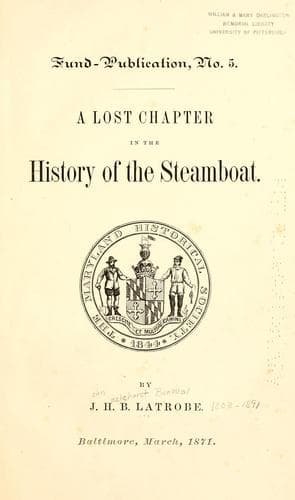
A Lost Chapter in the History of the SteamboatLatrobe, John H. B. (John Hazlehurst Boneval)
History
A Lost Chapter in the History of the Steamboat
Latrobe, John H. B. (John Hazlehurst Boneval)
Roosevelt, Nicholas J., 1767-1854; Steam-navigation -- History
The Chancellor was an inventor, but unlike most inventors was a man of
large wealth; and the result of the correspondence, thus commenced, all
of which is before me, was an agreement between the Chancellor,
Roosevelt, and John Stevens of Hoboken, to build a boat on joint
account, for which the engines were to be constructed at Second river by
Roosevelt, while the propelling agency employed was to be on the plan of
the Chancellor.
I have not been able to make out, from the very voluminous
correspondence, the precise character of the Chancellor’s contrivance;
but I infer that it consisted of wheels with vertical axes, submerged at
the stern, that forced a stream of water outward from between them, and
so propelled the vessel. The inventor’s own idea of it must have been
vague in the first instance; for there is scarcely a letter to Roosevelt
from the time the work was commenced, until it was abandoned, that does
not suggest changes and alterations. Steam appears to have been applied
to the machinery about the middle of the year 1798, unsuccessfully; and
the Chancellor, charging the failure to want of power in the engine,
proposes to throw the cost of it upon the builder. This is of course
resisted. Further improvements in the propellers are made. The engine is
then alleged to be _too_ powerful: and so matters go on, until the 21st
of October, 1798, when Roosevelt writes to the Chancellor, giving him an
account of a trial trip, on which the speed attained was equivalent to
about three miles in still water; though, with wind and tide, the
Spanish Minister, who was on board and highly elated, estimated the
actual speed at double that amount.
In the meanwhile however, on the 6th of September, 1798, Roosevelt wrote
to the Chancellor an important letter in this connection, in which,
after referring to a change in the plan, he says:
“I would recommend that we throw two wheels of wood over the sides,
fastened to the axes of the flys (fly wheels) with eight arms or
paddles; that part which enters the water of sheet iron to shift
according to the power they require either deeper in the water, or
otherwise, and that we navigate the vessel with these until we can
procure an engine of the proper size, which, I think, ought not to be
less than 24 inch cylinder.”
No better description of a side wheel steamboat has ever been given than
is contained in this letter of the 6th of September, 1798, the original
draft of which, with all its interlineations, is now before me; _and
this is the first practical suggestion of the combination which made
steam navigation a commercial success_, that there is a record of in
America; and this also, when, as late as 1802, four years later, Fulton,
as we are informed by his biographer, had become assured, that endless
chains and floats were alone to be relied on!
Public-domain text, read in full here on John Shaqi.
Reviews
Reviews
No reviews yet
Be the first to share your thoughts on this work.
Join the Discussion
Join the discussion
Sign in to leave a comment or review.
Sign InorCreate an account