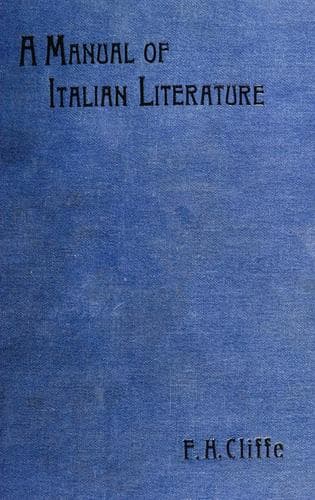
A manual of Italian literatureCliffe, Francis Henry
History
A manual of Italian literature
Cliffe, Francis Henry
Italian literature -- History and criticism
The vigorous mind of Lucretius suffered but little from reliance on
Greek models. But this was partly owing to the nature of his subject.
A philosopher is assisted, his mind is enriched, by the speculations
of his predecessors; and the fact of his writing in verse is but an
accident which in no way detracts from the truth of this remark. His
strength of mind and matchless powers of description make his poem
one of the finest monuments in the Latin language. Catullus had so
much sweetness and tenderness, a cast of thought at once so fiery and
so natural, that even the study of the most laboured performances
of Alexandrian pedants could not rob him of his spontaneity and
freshness. With Horace the case is somewhat different. He was deeply
read in the poets of Greece, and that course of study is visible in
every line he wrote. But he had the wisdom to select as models only
the sublimest passages of the noblest writers, and he adapted what he
borrowed from them with such exquisite art to his Roman surroundings,
that we may well ask whether he did not positively gain by having
Pindar, Alcæus and Sappho constantly before him. Still, the result is
artificial in a high degree, and the emotions that greater poets really
feel, he too often only simulates.
If we except many tender passages from Tibullus, many picturesque
passages from Ovid, and many vigorous passages from Lucan, Roman
Poetry presents us for centuries with nothing but feeble echoes of
Greek models, and those models too often the pedantic and lifeless
productions of Alexandria. A genuine Roman Drama may be said never to
have existed. Plautus and Terence are but pale reflections of the Attic
comedies; the tragedies attributed to Seneca, the only specimens that
have come down to us of Roman Tragedy, are but clumsy imitations, or
rather travesties, of Sophocles and Euripides. In the declining ages
of Roman Literature, Claudian was the only poet who showed genuine
originality and freshness of thought, and he, strange to say, was an
Alexandrian by birth, to whom the Latin language was not natural, but
acquired.
Public-domain text, read in full here on John Shaqi.
Reviews
Reviews
No reviews yet
Be the first to share your thoughts on this work.
Join the Discussion
Join the discussion
Sign in to leave a comment or review.
Sign InorCreate an account