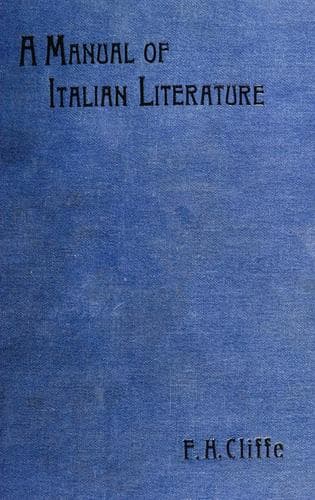
A manual of Italian literatureCliffe, Francis Henry
History
A manual of Italian literature
Cliffe, Francis Henry
Italian literature -- History and criticism
I know of no other instance of a great nation, victorious and dominant
over the whole civilised world, humbly sitting as a disciple at the
feet of one of her captives, and that not only for a short time,
but for the whole course of her intellectual development. Spain, in
the Sixteenth Century, borrowed many of her literary fashions from
Italy; England, in the Seventeenth Century, modelled her productions
in many respects on France, as did Germany somewhat later; but these
were merely transient fashions, not deep-rooted customs, and produced
no very lasting effect. Rome was alone, and has been since, in her
deference to a foreign model, nor can it be said in extenuation that
she had only the choice of having poetry on that model or no poetry at
all. She had plenty of indigenous material, and Niebuhr has well said
that the true poetry of Rome must be found in her history and in her
early legends rather than in the finished productions of her literary
poets.
This is all the more remarkable, as her greatness was such that it
could not fail to inspire even the least susceptible of minds. It made
itself felt from the shores of the Baltic to the Persian Gulf, and is
attested by ruins more substantial than the uninjured structures of
feebler races. Such was its inherent strength, that it withstood the
bloodiest civil wars and the most crushing despotism; nor is it easy
to surmise what could have undermined it, had not the immigration of
barbarian tribes from the mysterious and unexplored regions of the
North given shock after shock to that stately system, the work of so
many warriors and legislators. It may truly be said that the walls of
Rome fell at the blast of the Gothic trumpet.
When Constantine removed the seat of Empire to Constantinople, he broke
the spell that had for so many ages held the nations captive. The
partition of the Empire into East and West finished what the removal
began. Nor had Rome only the rivalry of Constantinople to dread. Milan,
and then Ravenna, became the scene of Imperial splendour ind the centre
of Imperial policy. Rome would, indeed, have been deserted but for her
Bishop, who was gradually establishing for himself and his successors a
dominion not less brilliant and more durable than that of the Cæsars.
Public-domain text, read in full here on John Shaqi.
Reviews
Reviews
No reviews yet
Be the first to share your thoughts on this work.
Join the Discussion
Join the discussion
Sign in to leave a comment or review.
Sign InorCreate an account