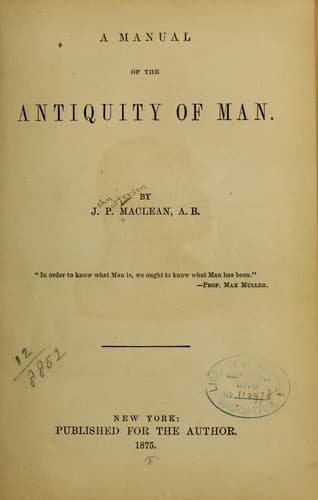
A Manual of the Antiquity of ManMacLean, J. P. (John Patterson)
History
A Manual of the Antiquity of Man
MacLean, J. P. (John Patterson)
Human beings -- Origin
In 1864, James Brown found flint implements midway between Gosport and
Southampton, included in gravel from eight to twelve feet thick, capping
a cliff which at its greatest height is thirty-five feet above
high-water mark. These flint tools exactly resemble those found at
Abbeville and Amiens. Some of them are preserved in the Blackmore Museum
at Salisbury.
In 1865, there was found in the loess of the Rhine, near Colmar, Alsace,
human bones in the same bed with bones of the mammoth, horse, stag,
auroch, and other animals.
In 1866, Alfred Stevens first dug out a hatchet from the gravel at the
top of the sea-cliff east of the Bournemouth opening, Southampton river.
Soon after, Dr. Blackmore, to the west of the valley, obtained two other
flint implements. The spot was examined by Lyell in 1867.
Dr. Edward Dupont, an eminent Belgian cave explorer, in the year 1866,
found a fragment of a human jaw in the Trou de la Naulette, a bone cave
situated on the bank of the river Lesse not far from Chaleux.
At the International Congress of 1867, M. A. Issel reported he had found
several human bones in beds of Pliocene age, near Savonia, in Liguria.
The Reindeer Station on the Schusse, in Swabia, was discovered in 1867,
during the operations undertaken for the improvement of a mill-pond. The
Schusse is a little river which flows into the lake of Constance, and
its source is upon the high plateau of Upper Swabia between the lake of
Constance and the upper course of the Danube.
In 1868, Thomas Codrington discovered an oval flint implement in gravel
at the top of the Foreland Cliff, Isle of Wight, five miles southeast of
Ryde.
The fossil Man of Mentone was discovered, in 1873, by M. Riviére, in a
cave near Nice, France. The skeleton was almost entire, and imbedded
twenty feet below the surface of the deposit.
In 1873, M. Riviére discovered another human skeleton, by the side of
which lay a few unpolished stone implements, in one of the caves in the
same neighborhood.
In 1873 and 1874, M. Riviére was again so fortunate as to discover, in
neighboring caves, the remains of three persons, two of them those of
children. The skeletons were in the same condition, and decked with
similar ornaments, as those he had previously discovered.
CHAPTER II.
GLACIAL EPOCH.
Happily for the Archæo-geologist, there is given him a point from which
to start in his researches into the antiquity of his race. Without it
his calculations would be very indefinite and his efforts would be shorn
of much of their interest. The Glacial Epoch, that has puzzled the mind
of both the geologist and the astronomer, is a guide-post where he may
not only look both ways, but also estimate the length of ages and number
the years of man. Nothing, then, is of more importance, in this
investigation, than an understanding of the condition of the earth prior
to the glacial, and the knowledge of the date and length of this epoch.
Public-domain text, read in full here on John Shaqi.
Reviews
Reviews
No reviews yet
Be the first to share your thoughts on this work.
Join the Discussion
Join the discussion
Sign in to leave a comment or review.
Sign InorCreate an account