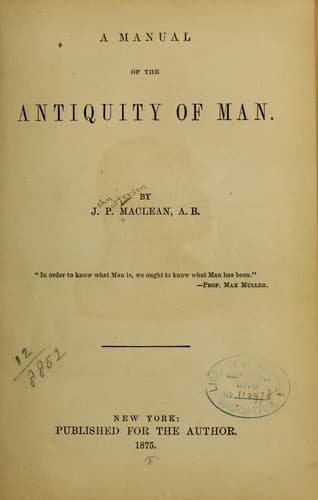
A Manual of the Antiquity of ManMacLean, J. P. (John Patterson)
History
A Manual of the Antiquity of Man
MacLean, J. P. (John Patterson)
Human beings -- Origin
For untold ages the earth, to all appearance, had been preparing itself
for the reception of man. There was an abundance of game, the forests
were beautiful, the domestic animals had made their appearance, the
climate was warm, the soil rich, and the coal had been formed.
Everything seemed to point to a bright and glorious future for man, who
had already entered upon the scene. It is true there were fierce and
savage beasts to contend with. These seemed but a motive power to stir
man to action and develop the resources of his mind. Should he fail for
a time to overcome the wild beasts a retreat was provided in the hollow
recesses of the earth. But nature felt her work was still unfinished.
The earth had passed through the ordeal of fire, and withstood the
devastations of water, and now her long summer must come to an end. The
arctic regions had been growing colder and colder, and the change was
felt in the countries to the south. The northern animals were being
clothed with a hairy or woolly garment for their protection. The aspect
began to be forbidding. The future prospect of man was not only gloomy,
but foreboded he should perish along with the many species of animals
that were gradually succumbing to the cold. Great fields of ice were
slowly accumulating at both the poles, and at last, by the power of
their great weight, assisted by some geographical changes, began to move
toward the equator, crushing and grinding the great rocks, and either
driving before them, or else destroying, every living thing in their
relentless march. Slowly but surely they moved on. The mountains groaned
under the enormous weight of ice. Their heads were scarred, their sides
bruised, torn and cut. The icy monsters listened not to the pleadings of
earth, the lowing of cattle, or the cries of man. Centuries elapsed
before the sun re-asserted his power. The rays of the sun, the internal
heat of the earth, and other causes, produced a change. The northern ice
was broken up by the time it reached latitude 39° North America, leaving
its indelible traces in the bowlders, gravel, beds of sand and clay
which mark its course. In Europe this sheet of ice extended as far south
as Spain and Corsica. The glaciers of the Antarctic regions extended as
far as latitude 41° south.
Public-domain text, read in full here on John Shaqi.
Reviews
Reviews
No reviews yet
Be the first to share your thoughts on this work.
Join the Discussion
Join the discussion
Sign in to leave a comment or review.
Sign InorCreate an account