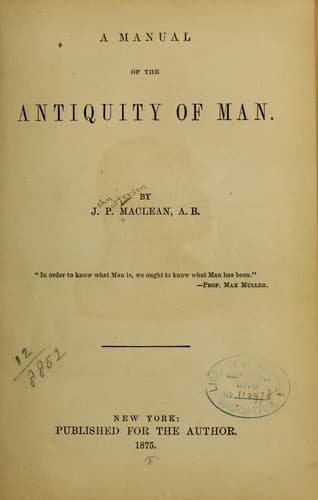
A Manual of the Antiquity of ManMacLean, J. P. (John Patterson)
History
A Manual of the Antiquity of Man
MacLean, J. P. (John Patterson)
Human beings -- Origin
IV. _Reindeer Epoch_; that period when the glaciers again advanced; in
which man's chief food consisted of the flesh of the reindeer (_C.
tarandus_), that animal having made its way in numerous herds as far
south as the Pyrenees.
V. _Neolithic Epoch_; that period in which man polished his weapons of
stone, and sought to domesticate certain animals, the dog, etc.
VI. _Bronze Epoch_; that period characterized by weapons and implements
being made chiefly of bronze.
VII. _Iron Epoch_; that period in which bronze was generally superseded
by iron.
This classification, on the whole, seems to be the best that could be
devised, for the reason it attempts to place the evidences of the
existence of man in their relative geological positions.
Other methods have misled the student. There was no universal Stone,
Bronze, or Iron Age. The classification given by Lubbock applies to
Europe, but is too general. I have adopted the word "Neolithic" for want
of a better term, although the signification of the word is appropriate
to the period it is intended to represent.
These various epochs are not sharply defined, the one from the other;
but one merges into the other by gradual progression covering a period
of thousands of years. The growth of the various plants and animals, and
their retreat or final extinction, have also been very slow.
An outline of the history of the discoveries which led to a careful
investigation of the question, and which resolved the question into a
science, is not only one of interest but also of importance to the
careful thinker seeking information on the subject.
Prior to the study of the ancient implements the "people had so little
notion of the nature and signification of the stone axes and weapons of
earlier and later times that they were regarded with superstitious fear
and hope, and as productions of lightning and thunder. Hence for a long
time they were called thunderbolts even by the learned.... As late as
the year 1734 when Mahndel explained in the Academy of Paris that these
stones were human implements, he was laughed at, because he had not
proved that they could not have been formed in the clouds."[3]
As early as the year 1700, a human skull was dug out of the calcareous
tuff of Constatt, in company with the bones of the mammoth. It is
preserved in the Natural History Museum at Stuttgart.
In the year 1715, an Englishman named Kemp found in London, by the side
of elephants' teeth, a stone hatchet, similar to those which have been
subsequently found in great numbers in different parts of the world.
This hatchet is still preserved in the British Museum.
In 1774, in the cavern of Gailenreuth, Bavaria, J. F. Esper discovered
some human bones mingled with the remains of extinct animals.
Public-domain text, read in full here on John Shaqi.
Reviews
Reviews
No reviews yet
Be the first to share your thoughts on this work.
Join the Discussion
Join the discussion
Sign in to leave a comment or review.
Sign InorCreate an account