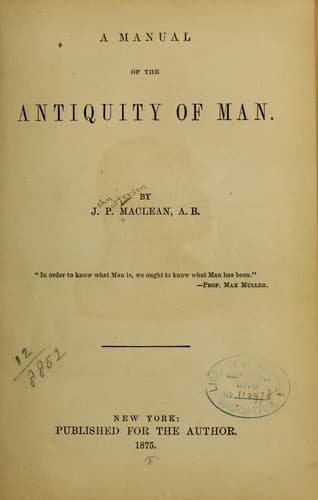
A Manual of the Antiquity of ManMacLean, J. P. (John Patterson)
History
A Manual of the Antiquity of Man
MacLean, J. P. (John Patterson)
Human beings -- Origin
In 1797, unpolished flint axes were dug out in great numbers from a
brick-field near Hoxne, county of Suffolk, where they occurred at a
depth of twelve feet, mingled with the bones of extinct species of
animals. They were gathered up and thrown by basketsful upon the
neighboring road. In the year 1801, before the Society of Antiquaries,
John Frere read a paper upon them, in which he stated that they pointed
to a very remote period. This communication, short as it was, contained
the essence of all subsequent discoveries and speculations as to the
antiquity of man. But the society regarded the subject as of no
importance.
During the construction of a canal (1815-1823) in Hollerd, there was
found, near Maestricht, in the _loess_, a human jaw in company with the
bones of extinct animals. This bone is preserved in the museum at
Leyden.
In 1823, Aimé Boué disinterred portions of a human skeleton from ancient
undisturbed loess near Lahr, a small village nearly opposite Strasbourg.
These bones were placed in the care of Cuvier, but, having been
neglected, are now lost.
In the same year, Dr. Buckland, an English geologist, published his
"Reliquiæ Diluvianæ," a work principally devoted to a description of the
Kirkdale Cave. The author combined all the known facts which favored the
coexistence of man, with the extinct animals.
In 1828, M. Tournal and M. Christol explored numerous caverns in the
south of France. In the cavern of Bize, Tournal found human bones and
teeth, and fragments of rude pottery, together with the bones of both
living and extinct species of animals, imbedded in the same mud and
breccia, cemented by stalagmite. The human bones were in the same
chemical condition as those of the extinct species.
M. Christol found in the cavern of Pondres, near Nimes, some human bones
in the same mud with the bones of an extinct hyena and rhinoceros.
In 1833, Dr. Schmerling explored the two bone-caverns of Engis and
Enghihoul (Belgium). In the former he found the Engis skull (now in the
museum of the University of Liége), at a depth of nearly five feet,
under an osseous breccia. The earth also contained the teeth of
rhinoceros, horse, hyena, and bear, and exhibited no marks of
disturbance. He also found the skull of a young person imbedded by the
side of a mammoth's tooth. It was entire, but so fragile, that it fell
to pieces before it was extracted. In the cave of Enghihoul he found
numerous bones belonging to three human individuals, mingled with the
bones of extinct animals. In these caves he noted rude flint
instruments, but did not collect many of them. In the care of Chokier,
he discovered a polished and jointed needle-shaped bone, with a hole
pierced through it, at its base. The caves of Engis and Chokier have
been annihilated, while only a part of Enghihoul remains.
Public-domain text, read in full here on John Shaqi.
Reviews
Reviews
No reviews yet
Be the first to share your thoughts on this work.
Join the Discussion
Join the discussion
Sign in to leave a comment or review.
Sign InorCreate an account