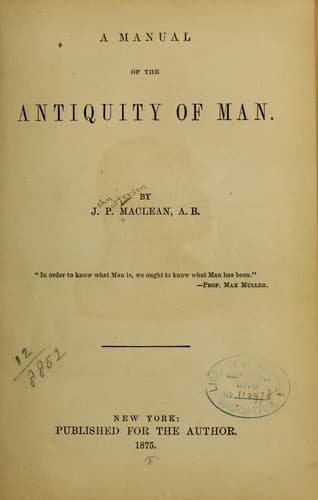
A Manual of the Antiquity of ManMacLean, J. P. (John Patterson)
History
A Manual of the Antiquity of Man
MacLean, J. P. (John Patterson)
Human beings -- Origin
by itself as monosyllabic, the only remnant of the earliest formation of
human speech."[103]
Anterior to these three families there was still another from which
these were derived. It contained the germs of all the Turanian, as well
as the Aryan and Semitic forms of speech. It belongs to that period in
the history of man when ideas were first clothed in language, and has
been called the Rhematic Period.[104]
As regards the origin of language, three theories have been proposed:
the Interjectional, the Imitation, and the Root. The first supposes that
the beginnings of human speech were the cries and sounds which are
uttered when a human being is affected by fear, pain, or joy. The second
supposes "that man, being as yet mute, heard the voices of birds, and
dogs, and cows, the thunder of the clouds, the roaring of the sea, the
rustling of the forest, the murmurs of the brook, and the whisper of the
breeze. He tried to imitate these sounds, and finding his mimicking
cries useful as signs of the objects from which they proceeded, he
followed up the idea and elaborated language." The third theory,
advanced by Max Müller, is that language followed as the outward sign
and realization of that inward faculty which is called the faculty of
abstraction, and the roots, to which language may be reduced, express a
general, not an individual idea.[105]
There is more or less truth in all these theories. At the very earliest
period man must have possessed some method of communicating his wants or
ideas. The casual observer has noticed that animals have methods of
communicating with one another. It is not improbable that at the very
earliest period man's only mode was that of cries and signs. This may
have lasted for a very long time. Then the mimicking commenced. Next,
comparison was resorted to when he had so far advanced as to describe
his thoughts and, finally, from these various beginnings, from necessary
or forced improvement, his ideas were expressed in root words.[106]
Instead of new languages originating, old languages change. They are
mutable, and from them new dialects are produced. In the history of man
there never has been a new language, and the languages now spoken are
but the modifications of old ones. The words now used by all people,
however broken up, crushed, or put together, are the same materials as
were used in the beginnings of speech. New words are but old words; old
in their material elements, though they may be renewed and dressed in
various forms. "The modifiability of the language and its tendency to
vary never cease, so that it would readily run into new dialects and
modes of pronunciation if there were no communication with the mother
country direct or indirect. In this respect its mutability will resemble
that of species, and it can no more spring up independently in separate
districts than species can, assuming that these last are all of
derivative origin."[107]
Public-domain text, read in full here on John Shaqi.
Reviews
Reviews
No reviews yet
Be the first to share your thoughts on this work.
Elsewhere in the archive
Join the Discussion
Join the discussion
Sign in to leave a comment or review.
Sign InorCreate an account