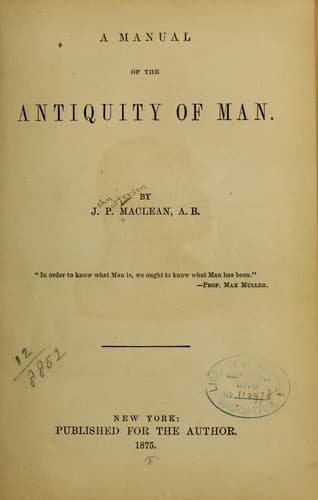
A Manual of the Antiquity of ManMacLean, J. P. (John Patterson)
History
A Manual of the Antiquity of Man
MacLean, J. P. (John Patterson)
Human beings -- Origin
Soon after these discoveries Dr. Schmerling published a work which
described and represented a vast quantity of objects which had been
discovered in the Belgian caverns. The scientific men were not yet
prepared to receive the new discoveries, and it attracted but little
attention at that time.
Too much praise cannot be bestowed upon Dr. Schmerling for his
unremitting labors. Of these labors Sir Charles Lyell has said: "To have
undertaken, in 1832, with a view of testing its truth (antiquity of
fossil human bones) to follow the Belgian philosopher through every
stage of his observations and proofs, would have been no easy task even
for one well-skilled in geology and osteology. To be let down, as
Schmerling was, day after day, by a rope tied to a tree, so as to slide
to the foot of the first opening of the Engis cave, where the
best-preserved human skulls were found; and, after thus gaining access
to the first subterranean gallery, to creep on all fours through a
contracted passage leading to larger chambers, there to superintend by
torchlight, week after week and year after year, the workmen who were
breaking through the stalagmitic crust as hard as marble, in order to
remove piece by piece the underlying bone-breccia nearly as hard; to
stand for hours with one's feet in the mud, and with water dripping from
the roof on one's head, in order to mark the position and guard against
the loss of each single bone of a skeleton; and at length, after finding
leisure, strength, and courage for all these operations, to look
forward, as the fruits of one's labor, to the publication of unwelcome
intelligence, opposed to the prepossessions of the scientific as well as
the unscientific public;--when these circumstances are taken into
account, we need scarcely wonder.... that a quarter of a century should
have elapsed before even the neighboring professors of the University
of Liége came forth to vindicate the truthfulness of their indefatigable
and clear-sighted countryman."[4]
In 1835, M. Joly, then professor at the Lyceum of Montpellier, found in
the cave of Nabrigas (Lozére) the skull of a cave-bear, on which an
arrow had left its mark. Close by, was a fragment of pottery marked by
the finger of the moulder.
Public-domain text, read in full here on John Shaqi.
Reviews
Reviews
No reviews yet
Be the first to share your thoughts on this work.
Join the Discussion
Join the discussion
Sign in to leave a comment or review.
Sign InorCreate an account