A Mechanico-Physiological Theory of Organic Evolution — John Shaqi
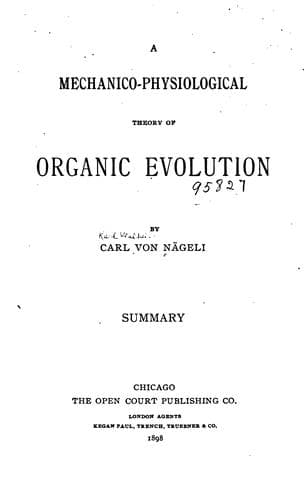
A Mechanico-Physiological Theory of Organic EvolutionNägeli, Carl
Science
A Mechanico-Physiological Theory of Organic Evolution
Nägeli, Carl
Evolution
Each ontogeny (individual) begins in a minute germ cell, in which a
small quantity of idioplasm is contained. In the cell divisions, by
which the organism grows, the idioplasm divides into as many parts as
there are single cells, while it continually increases in quantity in a
corresponding degree. The ontogenetic increase of the idioplasm takes
place by length growth of the strands--that is, by intercalation of
micellae in each row of cells of the strands, which thereby grow in
length without changing the configuration of the cross section.[C]
Accordingly, each strand of idioplasm contains all the determinants that
the particular individual has inherited in the germ cell, and each cell
of the organism is idioplasmatically qualified to become the germ cell
of a new individual. Whether this qualification may be realized depends
upon the nature of the soma-plasm. In the lower plants this power
belongs to each individual cell; in the higher plants many cells have
lost it; in the animal kingdom it is possessed in general only by cells
normally set apart as asexual or sexual reproductive cells.
[C] Hence, according to Naegeli, every cell of the organism has
idioplasm of identical structure. This at once suggests the
objection, how can the idioplasm, for instance, of a pollen
grain be the same as that of a leaf? Identical idioplasms should
always produce identical structures. Naegeli attempts to explain
this difficulty by attributing the different results to
different "conditions of tension and movement," i.e., a
dynamical difference between the idioplasms of the different
parts of the organism. (_Abstammungslehre_, p. 53.)
This idea of differences of structure being due to dynamic
rather than to material causes plays a considerable part in
Naegeli's theory, but is the point on which he speaks with least
certainty--in fact with a noticeable hesitation. He does not
clearly explain the phrase "conditions of tension and movement,"
nor does he give a convincing explanation of the known phenomena
as results of the action of dynamic influence.
Naegeli is not the only one who posits dynamic rather than
material differences as to the basis of diversities of
structure. More recently, Cope has built up a system of
evolution founded largely on this idea.--_Trans._
Public-domain text, read in full here on John Shaqi.
Reviews
Reviews
No reviews yet
Be the first to share your thoughts on this work.
Join the Discussion
Join the discussion
Sign in to leave a comment or review.
Sign InorCreate an account