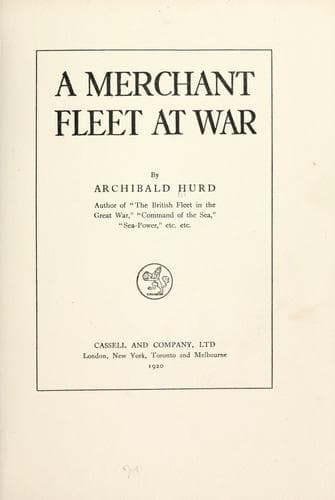
Cunard Steamship Company, ltd.; World War, 1914-1918 -- Naval operations
“I swam as hard as I could away from the vessel, and noticed with
feelings of apprehension the menacing bulk of the huge funnels as they
loomed up over my head. I expected them momentarily to fall on me
and crush me as I swam, but at last I judged myself to be clear, and I
turned round and trod the water in order to watch the great hull heel
over. The monster took a sudden plunge, and, noting the crowd still on
her decks and the heavily laden boats filling with helpless women and
children glued to her side, I sickened with horror at the sight. The
liner’s stern rose high out of the water; there was a thunderous roar
as of the collapse of a great building during a fire, and then she
disappeared, dragging hundreds of fellow-creatures into the vortex.
Many never rose again to the surface, but the sea rapidly grew black
with the figures of struggling men, women, and children. The wireless
installation came over with a crash into the sea. It struck my uplifted
arm as it fell, and I felt it pass over my body as it sank, almost
dragging me under.
“The rush of water over the steamer’s decks swept away a collapsible
boat, and I swam towards it. Another man reached it shortly after, and
after we were rescued I found him to be Mr. James Lauriat, jun., of
Boston. Two seamen also managed to swim to the boat and to climb on
to it. One had a knife, and the other asked me for mine, and together
they set about cutting away the canvas cover of the boat. When they
had finished, I climbed inside, and the three of them followed me. We
started to rescue the unfortunate people in the water, or at least
those of them who were still living. We quickly had about 30 of them in
the little craft. Around us in the water were scores of boats. There
were no oars in our boats. We managed to raise the sides of the boat as
they should be raised when the boat is in use, and we collected five
oars from the mass of floating timber in the water. Then we started
to row towards the lighthouse, which we could see in the distance.
At the time the liner was torpedoed there was absolutely no ship of
any kind in sight, with the exception of a trawler--the _Peel 12_, of
Glasgow; she was close inshore under the lighthouse, and, owing to
the lightness of the wind, she was of no use so far as the rescue of
persons actually in the sea was concerned. She came along as fast as
she could, however, and was able to pick up about one hundred and ten
persons from lifeboats and life-rafts. Her limited capacity was pushed
to the utmost, and I even had to sit with one leg hanging over
the sides because there was no room to put it on the inside. We took
in tow a lifeboat and a raft, which were also filled to the gunwale,
and when the occupants were able to be taken out they were cast off.
The auxiliary boat _Indian Prince_ had by that time arrived from
Queenstown. The _Peel 12_ was the first boat on the scene, and she was
followed by a tramp Greek steamer, which came up from the west, and was
Public-domain text, read in full here on John Shaqi.
Reviews
Reviews
No reviews yet
Be the first to share your thoughts on this work.
Join the Discussion
Join the discussion
Sign in to leave a comment or review.
Sign InorCreate an account