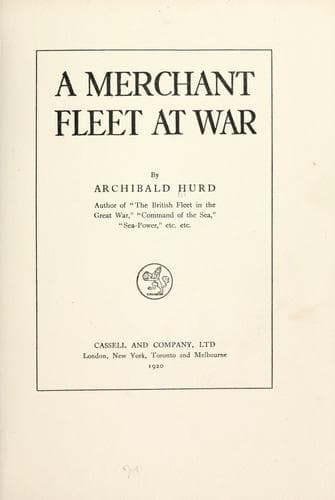
Cunard Steamship Company, ltd.; World War, 1914-1918 -- Naval operations
able to pick up several lifeboats which had got away.”
[Illustration: AMERICAN TROOPS NEVER FORGOT THE “LUSITANIA”]
Such was the experience of Mr. Brooks, and in his moving narrative we
can not only divine something of a tragedy beyond the scope of any
human pen, but gather also an impression of heroism, of unquestioning
devotion to duty, at which every member of the Cunard Company may well
thrill with pride.
Particularly noticeable perhaps, was the conduct and sound judgment of
the young sailor, Leslie N. Morton, to whom we have already referred,
and he was especially commended by Lord Mersey, the Commissioner in
charge of the formal investigation afterwards held into the loss of
the _Lusitania_. This boy, for he was only 18, had been stationed
as extra look-out on the forecastle head, starboard side, during the
fatal watch; and it was, as we have said, he who was the first to
perceive the approach of the torpedo. This began, as he described it,
with a “big burst of foam about 500 yards away.” This was followed by
a “thin streak of foam, making for the ship at a rapid speed, followed
by another going parallel with the first one, and a little behind it.”
Having immediately reported this through a megaphone to the bridge,
Morton made for the forecastle to go down below to call his brother
who was asleep, and on the way there he saw what he took to be the
conning-tower of a submarine just submerging.
Having called his brother, he went along the starboard side of the
main deck and up on to the starboard side of the bridge deck, where he
found the starboard boats useless owing to the vessel’s heavy list.
He then went to his own boat No. 13, and assisted in filling it with
passengers. Giving up his own seat, he then went to No. 11 boat, and
assisted in filling that one also; and it was in this one that he
eventually took his place. Unfortunately, owing it appears to the
unskillful action of some of the passengers, this lifeboat was unable
to push away from the ship, and it was eventually sunk. Morton then
swam for it and succeeded in reaching an empty collapsible boat, into
which he climbed, succeeding with the help of another young sailor,
Joseph Parry, in ripping off the cover and rescuing from the water some
50 people. He then made for a fishing kedge about five miles away,
and having reached it transferred his passengers to it, and returned
for some more, subsequently rescuing about 30 people from a sinking
lifeboat--the little collapsible boat being subsequently rescued by a
mine-sweeper. These two boys were thus instrumental in saving nearly
100 lives; and in recognition of their bravery they were awarded
decorations by the Board of Trade, Morton receiving the Silver Medal
for Gallantry, and Parry the Bronze Medal for Gallantry.
Public-domain text, read in full here on John Shaqi.
Reviews
Reviews
No reviews yet
Be the first to share your thoughts on this work.
Join the Discussion
Join the discussion
Sign in to leave a comment or review.
Sign InorCreate an account