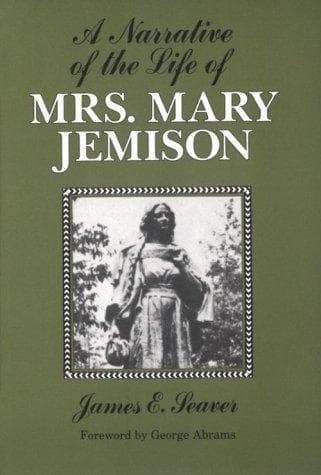
A Narrative of the Life of Mrs. Mary JemisonSeaver, James E. (James Everett)
History
A Narrative of the Life of Mrs. Mary Jemison
Seaver, James E. (James Everett)
Jemison, Mary, 1743-1833; Seneca Indians
A part of those nations live on the Sandusky, in the state of Ohio,
viz--380 Cayugas, 300 Senecas, 64 Mohawks, 64 Oneidas, and 80 Onondagas.
The bulk of the Mohawks are on Grand River, Upper Canada, together with
some Senecas, Tuscaroras, Cayugas, Oneidas, and Onondagas.
In the state of New-York there are 5000, and in the state of Ohio
688, as we are assured by Capt. Horatio Jones, agent for paying their
annuities, making in the whole, in both states, 5688.
* * * * *
OF THEIR COURTSHIPS, &c.
When an Indian sees a squaw whom he fancies, he sends a present to her
mother or parents, who on receiving it consult with his parents, his
friends, and each other, on the propriety and expediency of the proposed
connexion. If it is not agreeable, the present is returned; but if it
is, the lover is informed of his good fortune, and immediately goes to
live with her, or takes her to a hut of his own preparing.
Polygamy is practised in a few instances, and is not prohibited.
Divorces are frequent. If a difficulty of importance arises between a
married couple, they agree to separate. They divide their property and
children; the squaw takes the girls, the Indian the boys, and both are
at liberty to marry again.
They have no marriage ceremony, nor form of divorcement, other than what
has been mentioned.
* * * * *
OF FAMILY GOVERNMENT.
In their families, parents are very mild, and the mother superintends
the children. The word of the Indian father, however, is law, and must
be obeyed by the whole that are under his authority.
One thing respecting the Indian women is worthy of attention, and
perhaps of imitation, although it is now a days considered beneath the
dignity of the ladies, especially those who are the most refined; and
that is, they are under a becoming subjection to their husbands. It is
a rule, inculcated in all the Indian tribes, and practised throughout
their generations, that a squaw shall not walk before her Indian, nor
pretend to take the lead in his business. And for this reason we never
can see a party on the march to or from hunting and the like, in which
the squaws are not directly in the rear of their partners.
* * * * *
OF THEIR FUNERALS.
Public-domain text, read in full here on John Shaqi.
Reviews
Reviews
No reviews yet
Be the first to share your thoughts on this work.
Elsewhere in the archive
Join the Discussion
Join the discussion
Sign in to leave a comment or review.
Sign InorCreate an account