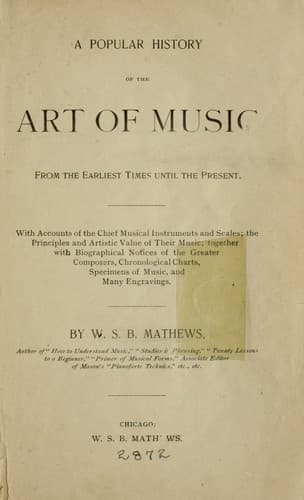
A Popular History of the Art of Music: From the Earliest Times Until the PresentMathews, W. S. B. (William Smythe Babcock)
History
A Popular History of the Art of Music: From the Earliest Times Until the Present
Mathews, W. S. B. (William Smythe Babcock)
Music -- History and criticism
Without pausing to trace the concert career of the young virtuoso it
must suffice to say, that by the time he was twelve years old, he had
become favorably known in every court of southern Europe. His talent
had been illustrated in many different ways, and tested by the most
severe masters. One of the most celebrated cases of this kind happened
at Bologna, where the Philharmonic Academy received him as a member,
after his passing the usual severe test, over which the famous master,
Padre Martini, presided. The conditions of membership required the
candidate to write an elaborate motette in six parts, founded upon a
melody assigned from the Roman Antiphonarium, the work to conform to
the strictest rules, with double counterpoint and fugue. In
consequence of the nervous feeling due to the limit of time allowed,
candidates very often failed. Mozart, however, took his paper in the
cheerful frame of mind which everywhere distinguished him, and was
duly locked up. In less than three-quarters of an hour he rapped at
his door and asked to be let out. The authorities sent him word not
to be discouraged, but to keep on trying, as he had yet three hours,
and might accomplish it. They were greatly astonished on finding that
he had already finished, having produced a complete master work,
abundantly up to all requirements, the whole written in his peculiarly
neat and accurate manner.
His compositions had already reached the number of eighty, including a
number of symphonies. It was now late in the year 1771, and at Milan
Wolfgang set seriously to work upon his opera, which was produced
December 26 and repeated to full houses twenty times, the author
himself conducting it. This was "_Mitridate, Re di Ponto_." The year
following he composed two other operas for Italy, and several
symphonies, so that when his new opera of "_Lucio Silla_" was
performed in Milan October 24, 1772, the number of his works had
reached 135. From 1773 to 1777 Mozart remained at Salzburg, with
occasional journeys to Vienna and other cities, always pursuing a life
of unflagging industry. The number of his works had increased by the
end of this period to upwards of 250, including an immense variety of
pieces of chamber music, symphonies, two or three operas, a number of
masses, and the like. He was now twenty-one years old, and since the
age of fourteen he had been assistant conductor at Salzburg in the
service of the prince archbishop, who was a small-souled man, wholly
unworthy the service which Mozart rendered him. There is at least a
small satisfaction in remembering that the archbishop himself had a
distinct impression of the dis-esteem in which he was held by his
talented young musical conductor.
Public-domain text, read in full here on John Shaqi.
Reviews
Reviews
No reviews yet
Be the first to share your thoughts on this work.
Elsewhere in the archive
Join the Discussion
Join the discussion
Sign in to leave a comment or review.
Sign InorCreate an account