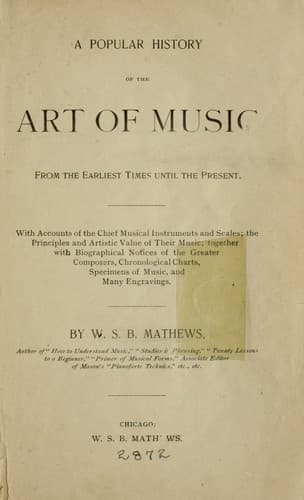
A Popular History of the Art of Music: From the Earliest Times Until the PresentMathews, W. S. B. (William Smythe Babcock)
History
A Popular History of the Art of Music: From the Earliest Times Until the Present
Mathews, W. S. B. (William Smythe Babcock)
Music -- History and criticism
In one sense there is a distinct difference between the symphonies of
Mozart and those of Beethoven. The passionate ideal, the picture of a
deep soul, tossed yet triumphant, is nearer to the latter. Whatever
Mozart may have experienced in the way of "contradiction of sinners"
(as St. Paul calls it), he never allows the fact to find entrance into
his music, and especially into his symphonies. Whether he felt that
these moments did not belong to a high ideal of orchestral pieces, or
whether he was glad to find in the tone world forgetfulness of sorrows
and troubles, we do not know. But Beethoven came nearer to the great
time of the romantic. The inherent interest of whatever belongs to the
human soul was an idea of his time, and unconsciously to himself,
perhaps, it entered into and colored his work. The ninth symphony
belongs to the period when Hegel was delivering his lectures upon the
deepest questions of philosophy, and laying it down as a fundamental
principle that it is the place of art to represent everything
whatever, which sinks or swells in the human spirit; not alone all the
noble and the lovely, but also the ignoble, the vicious, the unworthy,
and particularly the tragic--to the end that the soul may learn to
know itself, and awaken to a deeper and better self-consciousness.
Beethoven felt the mental movement of his day. While his acquaintance
with other prominent literary men of his time made little headway,
owing in part to his deafness, and in part to his very strong
self-consciousness, he read and thought, and felt himself akin with
the whole human race. He was a socialist and a republican by instinct.
"Man stands upon that which he really is," was a form of
self-assertiveness, which, if not actually enunciated by him, at least
represents his attitude toward the conventionalities and
superficialities of the courts, the social orders, and the general
movement of mind into which he entered. Moreover this was the time
when the romantic poets of Germany had already set the world thinking
their new ideas. Close by the great composer, in the same city in
fact, worked a young man, worshiping almost the very ground upon which
Beethoven walked, but for the most part unknown to him--Franz
Schubert, who in the symphony was classic to the very highest degree,
and a tone poet gifted lyrically not less than Mozart himself, a
composer whose ideas have equal refinement and grace with those of
Mozart, together with a certain charm peculiarly their own, and an
instinct for musical coloration, which has never found its superior.
This obscure young man, whose lofty genius was recognized only after
his soul had taken its flight from earth, was the founder of the
modern romantic school of music--the musical commentator upon the
productions of all the best of German poets; a composer of such
inexhaustible fertility and melodic inspiration that Schumann said of
him, that if he had lived he would have set to music the whole German
literature.
Public-domain text, read in full here on John Shaqi.
Reviews
Reviews
No reviews yet
Be the first to share your thoughts on this work.
Elsewhere in the archive
Join the Discussion
Join the discussion
Sign in to leave a comment or review.
Sign InorCreate an account