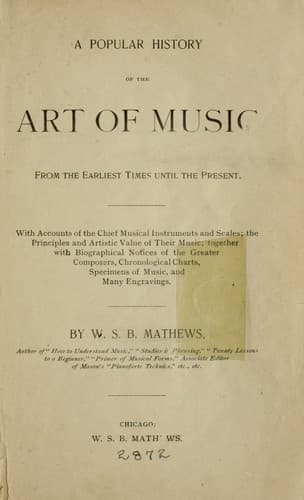
A Popular History of the Art of Music: From the Earliest Times Until the PresentMathews, W. S. B. (William Smythe Babcock)
History
A Popular History of the Art of Music: From the Earliest Times Until the Present
Mathews, W. S. B. (William Smythe Babcock)
Music -- History and criticism
We are told that within the next two or three years Schubert made a
number of friends, and the circle of his admirers was considerably
extended. The same remarkable productivity continued. In the summer of
1818 he went to the country seat of Count Esterhazy, where he remained
several months. This was in Hungary, and the Hungarian pieces are
supposed to date from his residence there. It was not until 1819 that
the first song of Schubert was sung in public. This was the
"Shepherd's Lament," of which the Leipsic correspondent of the
_Allgemeine Musikalische Zeitung_ says: "The touching and feeling
composition of this talented young man was sung by Herr Jaeger in a
similar spirit." The following year, among other compositions, was the
oratorio of "Lazarus," which was composed in three parts--first, the
sickness and death, then the burial and elegy, and, finally, the
resurrection. The last part, unfortunately, if ever written, has been
lost. He made attempts at operatic composition, producing a vast
amount of beautiful music, but always to indifferent librettos, so
that none of his music was publicly performed. It was not until 1827
and 1828 that his continual practice in orchestral writing resulted in
the production of real master works. In this year the unfinished
symphony in B minor was produced, in which the two movements that we
have are among the most beautiful and poetic that the treasury of
orchestral music possesses. The other was the great symphony in C,
which was first performed in Leipsic ten years after Schubert's death,
through the intervention of Schumann. During all these years since
leaving his father's school, Schubert had been living in a very modest
manner, with an income which must have been very small and irregular.
He was very industrious, usually rising soon after five in the
morning, and, after a light breakfast of coffee and rolls, writing
steadily about seven hours. The amount of work which he got through in
this way was something incredible. Whole acts of operas were composed
and beautifully written out in score within a few days. Upon the same
morning from three to six songs might be written, if the poems chanced
to attract him. He scarcely ever altered or erased, and rarely
curtailed. All his music has the character of improvisation. The
melody, harmony, the thematic treatment, and the accompaniment with
the instrumental coloring, all seem to have occurred to him at the
same time. It is only a question of writing it down. Very little of
his music was performed during his lifetime--of the songs, first and
last, many of them in private circles, and the last two or three years
of his life, perhaps twenty or twenty-five in public. A few of his
smaller orchestral numbers were played by amateur players, where he
may have heard them himself, but his larger works he never heard. All
that schooling of ear which Beethoven had, as an orchestral director
in youth, Schubert lacked. His studies in counterpoint had never been
Public-domain text, read in full here on John Shaqi.
Reviews
Reviews
No reviews yet
Be the first to share your thoughts on this work.
Elsewhere in the archive
Join the Discussion
Join the discussion
Sign in to leave a comment or review.
Sign InorCreate an account