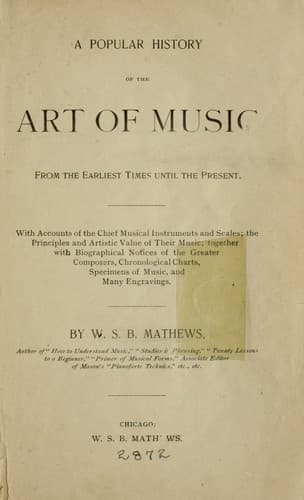
A Popular History of the Art of Music: From the Earliest Times Until the PresentMathews, W. S. B. (William Smythe Babcock)
History
A Popular History of the Art of Music: From the Earliest Times Until the Present
Mathews, W. S. B. (William Smythe Babcock)
Music -- History and criticism
player and occasionally as composer, until 1813, when he was appointed
musical director at Prague. The opera here was in very bad condition,
and the company incapable, but Weber engaged new singers in Vienna,
and entirely reorganized the affair, and conducted himself so
prudently that he gained the good will of nearly every one. As an
example of his quickness it may be mentioned that upon discovering
that certain musicians in the orchestra, who were not disposed to
yield to his strict ideas of discipline, were conversing with each
other in Bohemian, while the music was going on, he learned the
language himself sufficiently to rebuke them in their own tongue. His
next position was at Dresden in 1816, and here he remained nine years
until his death. His position at first was somewhat ambiguous. There
were two troupes of singers in the opera--an Italian and the German.
The grand operas were given in Italian by the Italian company, and the
light operas in German by the German company. It was Weber's task to
change this, by producing new works of a distinctly higher character
than the foreign works of the Italian company. The second year he was
able to produce a few good operas of other schools in German versions,
but it was not until 1821, when his "_Preciosa_" was produced at
Berlin, and 1822, when "_Der Freischuetz_" was produced in the same
theater, that the reputation of the young master was established
beyond question. It is impossible at the present time to describe the
enthusiasm which the latter work created. It was a new departure in
opera. It united two strains very dear to the German heart--the simple
peasant life and the people's song are represented in the choruses,
and in the arias of the less important people. Agatha, the heroine,
has a prayer of exquisite beauty, which still is often heard as a
church tune. And in contrast with these elements was the weird and
uncanny music of Zamiel, the Satanic spirit of the wood, and the
strange incantation scene in the Wolf's Glen at midnight, where the
magic balls are cast. The story was thoroughly German, and the music
not only German and well suited to the story, but distinctly original
and charming of itself. In this work, perhaps first of any opera,
Weber made use of what has since been known as "leading
motives"--characteristic melodic phrases appropriate to Zamiel and
Agatha. The instrumentation was very graphic, and as Weber had been
brought up upon the stage, there were many novelties of a scenic kind.
In fact, the work marked as distinct an epoch as Wagner's "Nibelungen
Ring," and what is more to the point, it was one of the operative
influences affecting the young Wagner, as he tells with considerable
care in his autobiography. His next effort was a comic opera, the
"Three Pintos," which was never finished. Then came "_Euryanthe_"
performed at Vienna in 1823 with the most extraordinary success. This
work is said to have been the model upon which Wagner created his
Public-domain text, read in full here on John Shaqi.
Reviews
Reviews
No reviews yet
Be the first to share your thoughts on this work.
Elsewhere in the archive
Join the Discussion
Join the discussion
Sign in to leave a comment or review.
Sign InorCreate an account